
Overview
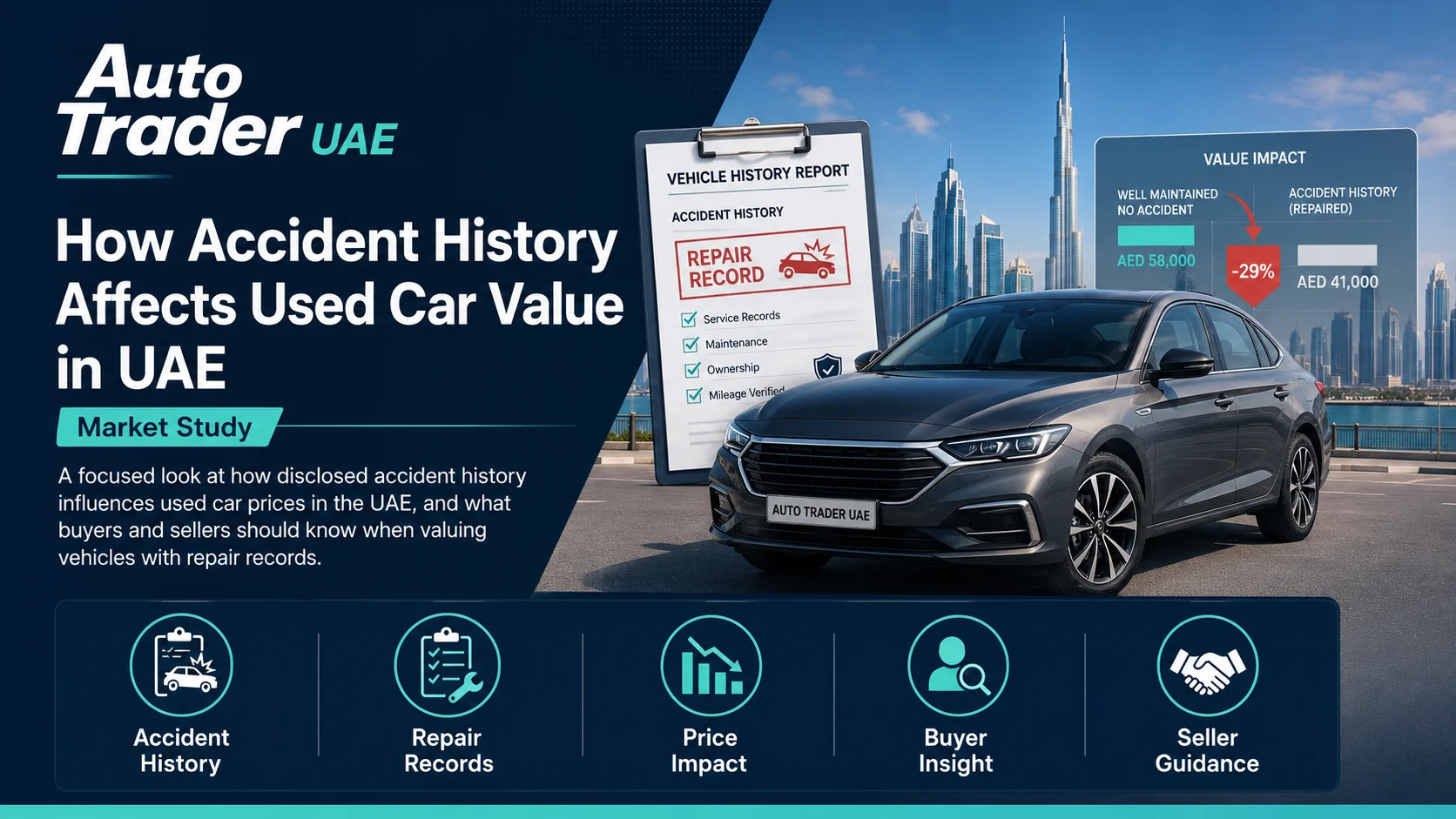
The UAE used car market has matured quickly. Buyers arrive with Carfax-style expectations, and sellers now operate in a landscape where accident history is rarely invisible. Between digital listings, insurance records, and vehicle history reports, a car’s repair trail is becoming part of its price. Accident history does not automatically make a car a bad purchase in the UAE, but it almost always affects how quickly it sells and the price it commands. This market study, based on listing behaviour and price patterns on Auto Trader UAE, outlines how buyers are reacting and how sellers are adjusting their pricing strategies.
• Family SUVs: Toyota Prado, Hyundai Tucson, Kia Sportage
• Premium SUVs: BMW X5, Mercedes-Benz GLE
• EVs and tech-heavy models: Tesla Model 3, Tesla Model Y
• Mass-market sedans: Toyota Corolla, Nissan Sunny
Methodology
This market study focuses on directional patterns rather than precise statistical claims. The analysis is based on:
- Observed asking-price ranges and time-on-market for accident-free vs disclosed-accident vehicles listed on Auto Trader UAE across 2023–2024.
- Comparisons within specific nameplates – for example, similar-year Toyota Prado, Nissan Patrol, and BMW X5 listings with and without declared accident history.
- Qualitative feedback from UAE dealers and workshop inspectors on buyer behaviour around accident disclosures and pre-purchase inspections.
- Public guidance from UAE authorities around vehicle registration, testing, and roadworthiness standards.
- Listing prices and descriptions on Auto Trader UAE, including explicit “accident-free” and “minor accident” claims
- Average visible time-on-market for popular models in Dubai, Abu Dhabi, and Sharjah
- Dealer commentary on trade-in valuations for vehicles with structural vs cosmetic repair history
- Inspection report summaries from independent garages and body shops
- Regulatory context from UAE authorities regarding registration of repaired vehicles
Relevant public references include:
- Dubai Roads & Transport Authority (RTA) – vehicle testing and registration requirements
- UAE Ministry of Interior – traffic safety and accident reporting framework
- Dubai Statistics Center – wider mobility and fleet context
- DEWA EV Green Charger – relevant for EV repair and ownership environment
- Official monthly fuel price announcements – context for demand in older, accident-repaired vehicles
Key Findings
- 1. Accident history consistently pushes prices down, but the size of the impact varies by segment.
Across Auto Trader UAE listings, vehicles with clearly disclosed accident and repair history usually appear at more aggressive asking prices than comparable “accident-free” examples. The discount is most visible in mid-age (3–7 years) cars where buyers have options.
Model examples: A 5-year-old Toyota Corolla or Nissan Sunny with a recorded front-end repair typically has to be priced below clean-history cars of similar mileage to attract leads. - 2. Buyers differentiate strongly between minor cosmetic damage and structural repairs.
Market feedback in the UAE shows a clear split: minor cosmetic repairs (bumper respray, panel repaint, small dent work) are widely accepted when documented, while structural damage (chassis, pillars, airbags) is heavily penalised. Listings that clearly label work as “minor accident, bumper & fender only” with invoices or photos tend to see better engagement than vague “accident repaired” notes.
Model examples: For popular family SUVs like the Hyundai Tucson or Kia Sportage, buyers often accept quality paint work but walk away quickly when inspection reports highlight structural frame pulls or multiple airbag deployments. - 3. High-demand SUVs hold value better, even with documented minor incidents.
Demand for capable SUVs and crossovers in the UAE means some models remain liquid despite a modest accident history, especially when repairs were done at reputable body shops and supported by invoices. In these cases, the pricing gap versus accident-free cars narrows, particularly during peak demand seasons.
Model examples: Well-maintained, documented minor-accident Toyota Prado and Nissan Patrol units frequently still command strong prices, provided service history is complete and off-road damage is ruled out by inspection. - 4. Premium and tech-heavy cars are more sensitive to accident history.
For premium German brands and EVs with complex safety and driver-assistance systems, UAE buyers show heightened caution. Even moderate accident history can trigger larger price reductions and slower sales, due to concerns about alignment, electronics, and long-term reliability.
Model examples: A repaired front collision on a BMW X5 or Mercedes-Benz GLE is often reflected in materially lower asking prices than pristine examples. Similarly, buyers of a used Tesla Model 3 or Model Y tend to push hard for discounts where repairs could affect battery cooling hardware or sensors. - 5. Transparent documentation reduces buyer resistance and time-on-market.
Listings that offer a clear story around the accident – including workshop invoices, before/after photos, and recent inspection reports – generally receive quicker inquiries than similar cars with vague or no explanation. In a disclosure-driven marketplace, transparency is increasingly treated as a value-preserving strategy.
Model examples: Dealers listing fleets of ex-rental sedans such as Toyota Corolla or Hyundai Elantra with attached inspection reports and detailed repair notes see stronger lead quality than those providing only basic descriptions. - 6. Repeated accident entries are a red flag that dramatically limit buyer pool.
Where vehicles show a pattern of multiple incidents over time, buyer appetite drops sharply. Even if each event was minor, repeated accident history suggests harder usage, higher insurance exposure, and potential alignment or structural fatigue issues.
Model examples: Multiple-incident history on popular ride-hailing favourites such as Nissan Sunny or Toyota Yaris often forces sellers into significant discounts, even if cosmetic repairs look tidy. - 7. Emirate testing rules and insurance experience influence perceptions.
Because vehicle testing and registration standards are enforced at emirate level under a national framework, buyers in Dubai, Abu Dhabi, and Sharjah increasingly rely on passing test results and inspection certificates as confirmation that accident-repaired cars remain roadworthy. However, many still factor in potential insurance premium impacts and future resale friction.
Model examples: A Dubai-tested accident-repaired Mitsubishi Pajero or Toyota Land Cruiser may sell acceptably if test certificates and inspection reports are fresh, but buyers still tend to benchmark pricing against clean-history alternatives.
Buyer Takeaway
For UAE buyers, accident history should be treated as a pricing signal, not an automatic deal-breaker. Focus on:
- Type of damage: Distinguish between cosmetic bodywork and structural or airbag-related repairs. The latter should command a much stronger discount and only be considered with expert inspection.
- Quality and transparency of repairs: Prefer vehicles with clear workshop invoices, photos, and recent independent inspections. Use third-party inspections for higher-value vehicles such as a used BMW X5 or Tesla Model 3.
- Resale impact: Assume that any accident history you accept today will be reflected again when you sell. Negotiate accordingly so that future resale discounts are already priced in.
- Model liquidity: Mainstream models such as Corolla, Tucson, and Patrol with minor, well-documented repairs can represent good value if priced correctly.
Using Auto Trader UAE’s filters to compare asking prices for accident-free vs disclosed-accident vehicles in the same year, trim, and mileage band is a practical way to benchmark what discount is actually achievable in the current market.
Seller Takeaway
For sellers – private or dealer – the market is rewarding transparency more than ever. Key actions:
- Price realistically against clean-history stock: Check competing listings on Auto Trader UAE for the same model and year. If your car has accident history, build a clear, defensible discount into the asking price rather than waiting for buyers to discover it during inspection.
- Tell the full repair story: Provide invoices, body shop details, and photos where possible. A well-presented, minor-accident Hyundai Tucson or Kia Sportage with paperwork often sells faster than a supposedly “clean” car with missing history.
- Invest in a pre-sale inspection: For higher-value SUVs like Prado or Patrol, commissioning a third-party inspection and sharing the report can reduce buyer doubt and protect value.
- Avoid under-declaring: In a connected market, failing to disclose accident history can backfire at the test centre or during inspection, leading to lost trust, cancelled deals, and lower eventual selling prices.
Aligning your listing narrative with official testing results and clear documentation is increasingly critical in Dubai, Abu Dhabi, and Sharjah, where buyers are attuned to both accident history and the cost of ownership.
Conclusion
Accident history has become a structural part of how used cars are priced and traded in the UAE. The direction of travel is clear: better documentation, more transparent listings, and buyers who expect to see a full picture before committing. Well-repaired, minor-incident vehicles are not being pushed out of the market; instead, they are being repriced and repositioned. High-demand SUVs and mainstream sedans can still perform strongly with a modest, well-documented accident record, while premium and tech-heavy models face sharper scrutiny and steeper discounts when damage goes beyond cosmetics. For both buyers and sellers, the practical response is the same: use accident history as a structured input into pricing, supported by inspections, testing records, and clear paperwork. That approach minimises surprises and turns what used to be a hidden risk into a negotiable, visible factor in every transaction. To compare real-world pricing for vehicles with and without disclosed accident history, browse live used cars in UAE and city-focused stock such as used cars in Dubai on Auto Trader UAE, where transparent listings and wide model coverage help you benchmark the market with confidence.
For a closer view of how these market shifts are playing out, Browse used cars in UAE on Auto Trader UAE to compare live listings, prices, and current market activity more clearly.
Explore Live Inventory
- Browse used cars in UAE
- See used Toyota Land Cruiser listings
- See used Nissan Patrol listings
- See used Toyota Prado listings
- See used Toyota Corolla listings
- See used Tesla Model 3 listings
- See used Tesla Model Y listings
- See used Hyundai Tucson listings
- See used Kia Sportage listings
- See used Toyota RAV4 listings
- See used Nissan X-Trail listings
- Read more Auto Trader UAE market studies
Frequently asked questions about How Accident History Affects Used Car Value in UAE: Market Study
Is How Accident History Affects Used Car Value in UAE: Market Study a good choice for driving in Dubai and the UAE?
Yes, How Accident History Affects Used Car Value in UAE: Market Study is well suited to Dubai and UAE conditions thanks to powerful air conditioning, smooth highway performance and a comfortable cabin that works well for long drives between emirates.
Is How Accident History Affects Used Car Value in UAE: Market Study fuel efficient for daily use in Dubai?
Actual fuel efficiency for How Accident History Affects Used Car Value in UAE: Market Study depends on traffic and driving style, but many Dubai buyers focus more on comfort and power. If you drive mostly on highways with smooth acceleration, you can keep the fuel consumption reasonable.
Is it easy to find used How Accident History Affects Used Car Value in UAE: Market Study models in Dubai?
In Dubai you can usually find used How Accident History Affects Used Car Value in UAE: Market Study listings from dealers and private sellers, especially in the luxury segment. Platforms like Auto Trader UAE make it easier to compare prices, mileage and specs for used examples.
What should I check before buying a used How Accident History Affects Used Car Value in UAE: Market Study in the UAE?
Before buying a used How Accident History Affects Used Car Value in UAE: Market Study in the UAE, check full service history, any accident or repaint records, suspension condition, tyre age, air-conditioning performance and electronics. A pre-purchase inspection is strongly recommended in the Dubai market.