
Overview
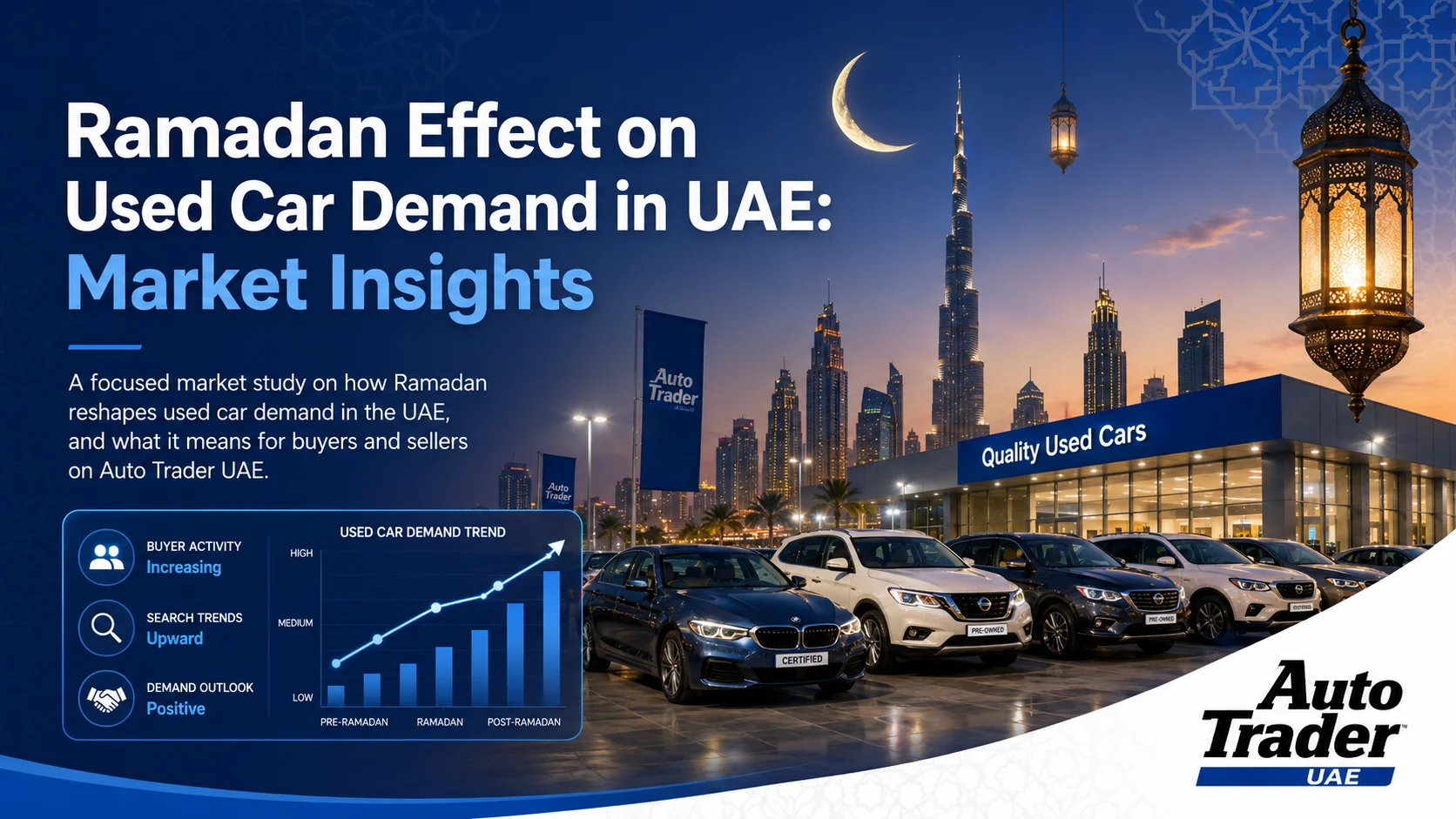
Ramadan has become one of the most important seasonal periods for the UAE automotive market, especially for used cars. While new car dealers traditionally dominate Ramadan advertising with finance and service bundles, the used market has developed its own patterns of demand, pricing, and buyer behaviour. For Auto Trader UAE users, Ramadan now acts as a demand accelerator rather than a simple discount season. Activity typically concentrates around the weeks just before and during Ramadan, then tapers towards Eid as many buyers finalise decisions.
- Family SUVs and crossovers: Toyota Prado, Nissan Patrol, Hyundai Tucson, Mitsubishi Pajero
- Fuel‑efficient commuters: Toyota Corolla, Nissan Sunny, Honda Civic
- Entry luxury and premium SUVs: BMW X5, Mercedes‑Benz GLE, Lexus RX
- EVs and hybrids in major cities: Tesla Model 3, Tesla Model Y, Toyota Camry Hybrid
Methodology
This report is a directional market study based on observed patterns in the UAE used car ecosystem around recent Ramadan periods. It combines platform and market signals to highlight commercially relevant trends rather than deliver precise statistical forecasts. The analysis draws on:
- Listing and enquiry behaviour patterns visible in the UAE used car market, including demand for used cars in UAE and city‑level activity such as used cars in Dubai.
- Typical dealer Ramadan campaign structures (finance, trade‑in, and warranty offers) and their spillover impact on used vehicles.
- Macroeconomic and regulatory context from UAE government and emirate‑level agencies.
- Publicly available information from official entities; these are used for context, not to derive exact numeric demand estimates.
- Seasonal changes in search interest and listing churn for popular nameplates (e.g. Toyota Prado in Dubai, Nissan Patrol in Dubai).
- Shift towards fuel‑efficient and family‑oriented models leading into and during Ramadan.
- Dealer advertising intensity and finance availability across the wider UAE market.
- Policy and infrastructure updates that indirectly influence used demand (fuel price changes, EV charging coverage, registration and testing processes).
Relevant official references for the broader context include:
- Dubai Roads & Transport Authority (RTA) – registration, testing and licensing frameworks.
- Dubai Statistics Center – macroeconomic and population indicators.
- UAE Ministry of Energy and Infrastructure – monthly fuel price announcements (via approved channels).
- DEWA – EV Green Charger network and charging tariffs in Dubai.
- UAE Ministry of Interior – federal traffic and vehicle regulations.
Key Findings
- 1. Pre‑Ramadan is the most competitive window for in‑demand used cars
Buyer enquiry levels for sought‑after models tend to rise in the weeks just before Ramadan as households plan mobility and budgets for the holy month and summer.
Examples: Clean, low‑kilometre Toyota Prado, Nissan Patrol, and BMW X5 often attract multiple serious enquiries when correctly priced in this period. - 2. Ramadan enhances, rather than reverses, existing demand trends
Ramadan does not typically create demand for models that are weak year‑round; instead, it amplifies interest in body types that already fit UAE usage patterns – especially 7‑seat SUVs, economical sedans, and mid‑size crossovers.
Examples: Family‑oriented Mitsubishi Pajero, Hyundai Tucson, and Toyota Land Cruiser typically see above‑average engagement, while niche coupes or heavy‑performance models show a more muted Ramadan effect. - 3. Finance offers on new cars influence used pricing expectations
Aggressive Ramadan campaigns by franchised dealers on new models – often featuring low‑installment or zero‑downpayment structures – can shift buyer reference points. Some used buyers anchor against new‑car monthly repayments rather than headline prices.
Impact on used models: A buyer comparing a new financed crossover may negotiate harder on a used Nissan X‑Trail, Kia Sportage or Hyundai Tucson, expecting the seller to reflect the difference in warranty coverage and finance convenience. - 4. Fuel price sensitivity is more visible during Ramadan driving patterns
Late‑evening and inter‑emirate travel often increases during Ramadan, making running costs more salient. With regulated fuel prices announced monthly by UAE authorities, months where petrol is higher tend to support demand for efficient used sedans and hybrids.
Examples: Strong interest around Ramadan for used Toyota Corolla, Nissan Sunny, and hybrids like Toyota Camry Hybrid or Lexus ES Hybrid is consistent with this pattern. - 5. EV and hybrid interest grows in Dubai and Abu Dhabi during night‑driving months
With cooler evening temperatures and increased night driving to and from iftar and suhoor gatherings, electric and hybrid cars become more practical for many households. Public charging coverage – particularly DEWA’s Green Charger network – supports used EV adoption.
Examples: Demand for used Tesla Model 3, Tesla Model Y and plug‑in hybrids like Mitsubishi Outlander PHEV shows more activity in major cities around Ramadan than in quieter off‑season months. - 6. Pricing flexibility increases, but only within realistic market bands
Many sellers perceive Ramadan as a time when they “must” offer a deal. In practice, Ramadan discounts in the used segment are typically modest. Buyers are more likely to secure value through service history, tyres, and registration validity than deep price cuts.
Examples: For popular models such as Toyota Camry in Dubai or Honda Civic in Dubai, well‑documented cars tend to sell close to prevailing market prices even during Ramadan; weaker examples often need price corrections regardless of the season. - 7. Registration timing and testing slots can affect closing speed
Vehicle inspection and registration requirements – overseen by authorities such as Dubai’s RTA and emirate‑level traffic departments – remain mandatory regardless of the season. Around Ramadan, buyers pay more attention to how much registration is remaining to avoid administrative tasks during shorter working days.
Examples: A used Nissan Patrol in Dubai or Toyota Prado in Abu Dhabi with nearly a full year of registration can close faster than a similar car needing immediate testing and renewal, even if priced slightly higher.
Buyer Takeaway
For buyers using Auto Trader UAE during Ramadan, the market is active but not irrational. A few practical implications stand out:
- Move early in the month for prime stock. Clean examples of high‑demand models – especially Toyota Land Cruiser, Nissan Patrol, and Lexus RX – tend to attract several serious buyers once listed.
- Focus negotiation on total cost, not only price. Service records, tyre condition, remaining warranty, and registration validity often deliver more real value than chasing an extra small discount.
- Keep alternatives ready. When browsing used cars in UAE, shortlist two or three comparable vehicles; Ramadan enquiry volumes mean a single target car can sell quickly.
- Consider city‑specific stock. Inventory can vary by emirate: for example, used cars in Dubai may show more EV and premium SUVs, while Sharjah and Ajman often list value‑oriented sedans and MPVs.
Seller Takeaway
For private and trade sellers, Ramadan is less about slashing prices and more about disciplined presentation and response:
- List just before or early in Ramadan. This captures the strongest wave of decision‑ready buyers. Aligning your listing window with pay cycles can further support demand.
- Price to market, not to expectations. Comparing your car with similar live listings on Auto Trader UAE – especially in the same emirate and mileage band – is more effective than asking prices based solely on older purchase invoices.
- Invest in transparency. High‑resolution photos, documented service history and clear mention of any recent work (brakes, tyres, major services) are particularly valuable when buyers are short on time during Ramadan.
- Respond quickly to enquiries. Many buyers schedule viewings around iftar and late evening; fast replies increase the chance of converting leads to viewings and deposits before they move on to other options.
- Highlight registration and testing status. Emphasising valid registration and recent passing of inspection can differentiate your car from similar listings, especially for larger SUVs and luxury models.
Conclusion
Ramadan’s effect on used car demand in the UAE is best understood as an intensification of normal market dynamics rather than a complete reset. The holy month concentrates serious buyers into a shorter window, reinforces demand for practical family SUVs and economical sedans, and magnifies the role of finance conditions and fuel prices in purchasing decisions. For buyers, the opportunity lies in clear preparation: knowing target models, monitoring listings closely, and being ready to act quickly on well‑priced, well‑documented vehicles. For sellers, the advantage comes from professional‑grade listings, realistic pricing, and responsive communication that converts heightened seasonal traffic into completed transfers. As the UAE market continues to evolve – with growing EV infrastructure, changing fuel prices, and ongoing urban development – the Ramadan effect is likely to remain an important seasonal marker for used car demand. To explore live opportunities this season, start with the full selection of used cars in UAE or browse city‑focused stock such as used cars in Dubai on Auto Trader UAE.
For a closer view of how these market shifts are playing out, Browse used cars in UAE on Auto Trader UAE to compare live listings, prices, and current market activity more clearly.
Explore Live Inventory
- Browse used cars in UAE
- See used Toyota Land Cruiser listings
- See used Nissan Patrol listings
- See used Toyota Prado listings
- See used Toyota Corolla listings
- See used Tesla Model 3 listings
- See used Tesla Model Y listings
- See used Hyundai Tucson listings
- See used Kia Sportage listings
- See used Toyota RAV4 listings
- See used Nissan X-Trail listings
- Read more Auto Trader UAE market studies