
Overview
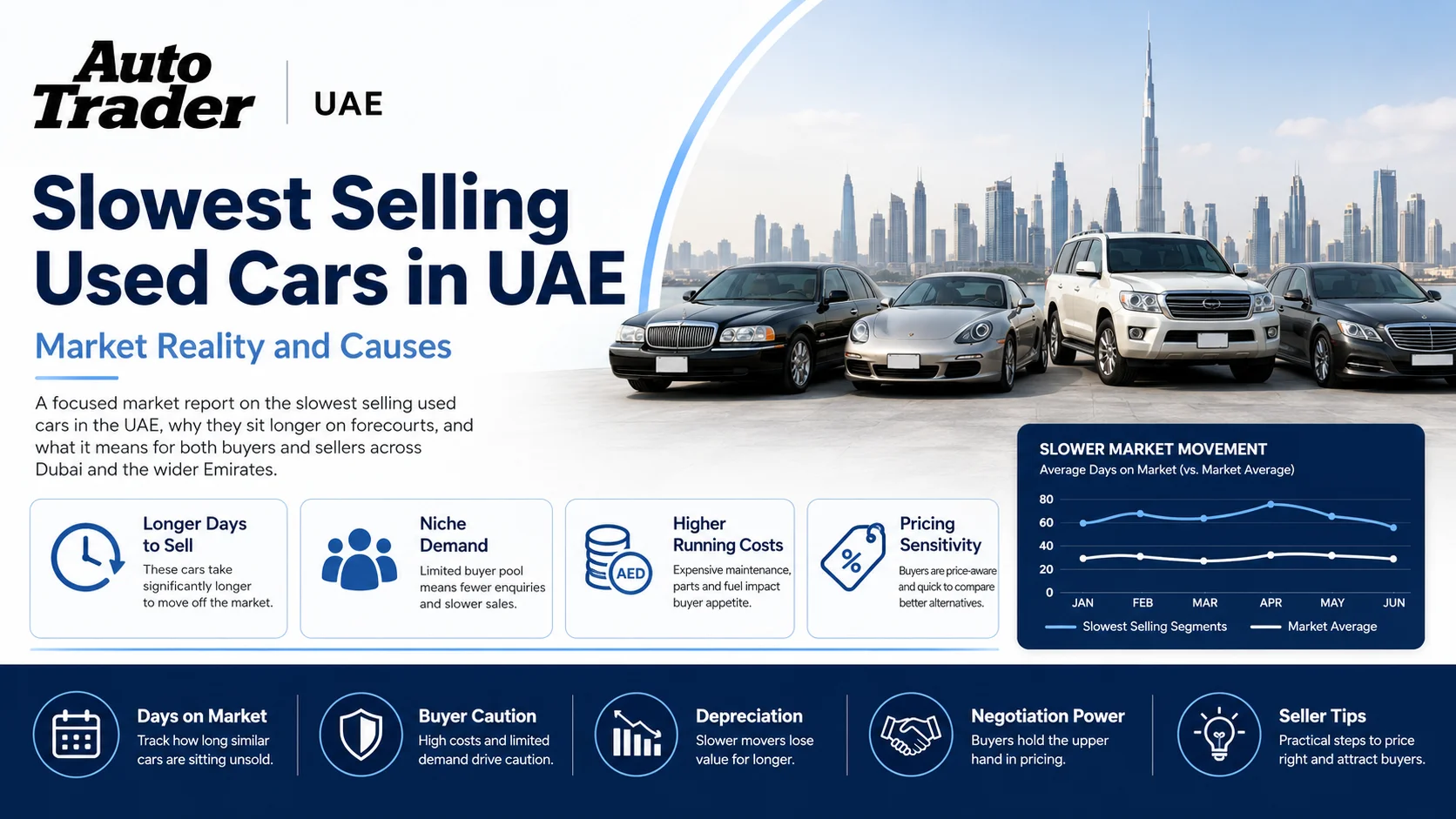
The UAE used car market has moved fast over the past two years, with strong demand for popular Japanese SUVs, fuel‑efficient sedans, and well‑specced German crossovers. Yet not every model turns quickly. A visible group of vehicles sits on classifieds and dealer forecourts for noticeably longer, even when prices look tempting. This report examines the slowest selling used cars in the UAE and the underlying causes. Rather than naming a fixed “bottom 10”, the focus is on segments and patterns that repeatedly show longer days‑to‑sale on platforms such as used cars in UAE, dealer stock lists, and auction outcomes.
While some nameplates slow down, demand remains healthy for mainstream, trusted models such as: These faster movers highlight how fuel efficiency, serviceability, and brand trust shape resale velocity.
Methodology
This market study combines several directional indicators rather than publishing exact days‑to‑sale figures, which vary between dealers, emirates, and price points. Key inputs include:
- Listing behaviour and price changes across used cars in UAE and city‑specific pages such as used cars in Dubai.
- Observed time‑on‑market ranges for specific segments (large luxury sedans, high‑displacement SUVs, niche coupes, older premium EVs).
- Feedback from independent dealers and traders on slow‑moving inventory and discount expectations.
- Publicly available information on fuel prices, EV charging, and registration/inspection rules that influence buyer behaviour.
- Fuel price trends posted via the UAE Fuel Price Committee (monthly pump price updates).
- Vehicle registration and testing rules from Dubai’s Roads and Transport Authority (RTA) and other emirate authorities.
- Population, income, and car ownership trends from Dubai Statistics Center and other official UAE sources.
- EV charging network information from DEWA Green Charger and other utilities.
- Traffic safety and modification regulations from the UAE Ministry of Interior.
The analysis is directional and intended to guide pricing, stocking, and purchase decisions rather than serve as a precise statistical ranking.
Key Findings
- 1. Big luxury sedans are the classic slow movers
Large, high‑spec German and Japanese sedans over a certain age cluster (typically 6–10 years old) often sit longest on the market. Buyers in the UAE have shifted heavily towards crossovers and سيارة SUV models, leaving flagship saloons with shrinking demand outside executive fleets and enthusiasts.
Typical slow movers:
– Older Mercedes‑Benz S‑Class and E‑Class (especially V6/V8 petrols)
– BMW 7 Series and some 5 Series trims
– Lexus LS and GS models
These cars attract interest but not fast commitments, mainly due to perceived maintenance and electronics costs after warranty. On portals such as used Mercedes‑Benz in Dubai and used BMW in UAE, the fastest clicks go to smaller, newer models rather than decade‑old flagships. - 2. High‑displacement petrol SUVs face resistance at pump‑sensitive price points
Demand for capable SUVs remains strong, but not every big vehicle sells fast. When fuel prices are elevated, buyers become noticeably more selective about V8 or large V6 SUVs that are not iconic nameplates.
Typical slow movers:
– Older American full‑size SUVs (e.g. some Chevrolet Tahoe/Suburban, Ford Expedition, GMC Yukon generations)
– Heavily optioned V8 European SUVs without full service history
– Large Japanese SUVs in less popular specs or grey‑import trims
Where buyers readily absorb fuel costs on legends like Nissan Patrol in Dubai or Toyota Land Cruiser in UAE, they bargain much harder on non‑iconic large SUVs. Stock without panoramic service records or GCC specs tends to linger. - 3. Niche coupes and convertibles have a narrow buyer base
Two‑door sports coupes and convertibles suffer from seasonality (less attractive in the peak summer heat) and a smaller audience of enthusiasts. In a family‑oriented market, these cars are rarely the household’s primary vehicle, which slows decision‑making and price acceptance.
Typical slow movers:
– Mid‑range German coupes and convertibles (e.g. BMW 4 Series, Audi A5 Cabriolet, Mercedes‑Benz C‑Class Coupé)
– Older American muscle cars that are non‑GCC or heavily modified
Well‑presented, stock examples with documented service records still sell, but days‑to‑sale are commonly longer than for mainstream four‑door models such as Toyota Camry used in UAE or Honda Accord in Dubai. - 4. Older premium EVs and plug‑ins show a mixed resale pattern
With expanding DEWA and other emirate charging networks, late‑model EVs such as the Tesla Model 3 in UAE or Tesla Model Y used attract strong interest. However, first‑generation premium EVs and plug‑in hybrids can be noticeably slower to move.
Typical slow movers:
– Early luxury EVs with limited range and out‑of‑warranty batteries
– Low‑volume plug‑in hybrids from European brands that buyers are unfamiliar with
Concerns over battery replacement cost, software support, and resale value in a still‑evolving segment make buyers more cautious. Transparent battery health reports and official‑dealer service history help, but pricing must often be more aggressive than owners expect. - 5. Non‑GCC and heavily modified imports take longer to clear
Across multiple segments, non‑GCC import status is one of the clearest signals of slower resale. Cars imported from North America, Europe, or Asia that lack clear accident and service history usually attract extended questioning at showings and more limited finance options.
Typical slow movers:
– Salvage‑rebuild imports of popular models (e.g. Toyota Corolla, Honda Civic, Hyundai Elantra)
– Modified performance cars with aftermarket suspension, exhausts, or remaps
Buyers are increasingly aware of inspection requirements and modification rules enforced by authorities such as the UAE Ministry of Interior and هيئة الطرق والمواصلات دبي. In contrast, clean GCC‑spec examples of the same models, listed on trusted portals like used Toyota in UAE or used Hyundai in UAE, typically clear more quickly. - 6. Under‑equipped base trims are overshadowed by better‑specced rivals
In a market where buyers expect sunroof, alloy wheels, advanced infotainment, and driver‑assistance features, basic trims of otherwise popular cars can be slower to sell, especially when better‑equipped alternatives are available for a small premium.
Typical slow movers:
– Entry‑level compact sedans without alloy wheels or infotainment upgrades
– Fleet‑spec SUVs with cloth interiors and minimal safety tech
For instance, a base‑spec small سيارة SUV may move slowly beside a mid‑spec Hyundai Tucson in UAE or Kia Sportage used, where the monthly finance difference is marginal but perceived value is far higher.
Buyer Takeaway
For private buyers, slow‑moving segments can represent real opportunity, provided you approach them analytically.
- Leverage slower demand to negotiate: On large sedans, older premium SUVs, and niche coupes, sellers often accept deeper discounts to avoid further holding costs. Compare multiple listings across Dubai used car inventory before committing.
- Model over badge: Within a brand, some nameplates move much faster than others. A well‑chosen Toyota Corolla, Hyundai Tucson, or BMW X5 will be easier to exit later than a rarely seen trim or experimental model.
- Check total ownership cost: Use fuel price trends, insurance quotes, and realistic maintenance expectations to decide if a bargain V8 or older luxury EV is truly cheaper over three to five years than a newer, more efficient car.
- Prioritise GCC‑spec and documented history: Non‑GCC or heavily modified imports may come cheap but can be harder to register, insure, or resell. A clean GCC car with full records is safer, even if the upfront price is slightly higher.
- Think about your own exit: If you plan to change cars within two to three years, favour liquid models such as Toyota Prado used in UAE or Nissan Patrol used in UAE over niche vehicles that already sell slowly today.
Seller Takeaway
Owners and dealers holding stock in these slow‑moving segments need to be proactive to avoid extended time‑on‑market.
- Price realistically from day one: Online buyers benchmark against similar listings across the UAE in minutes. Overpricing an older luxury sedan or high‑displacement SUV by even a modest margin can push it to the bottom of search results and extend holding time.
- Over‑communicate running costs: Provide recent service invoices, tyre dates, and honest fuel consumption expectations. Transparency on costs makes buyers more comfortable with cars that appear thirsty or complex.
- Invest in cosmetic and mechanical readiness: Slow segments are unforgiving of visible defects. A full detail, minor paint correction, and clearing dashboard warning lights can move a car into the shortlist for serious buyers browsing used cars in UAE.
- Highlight GCC‑spec, service history, and approvals: For imports or modified vehicles, show workshop reports and proof of any approvals required under UAE rules. For GCC cars, emphasise full dealer service history and verify mileage before listing.
- Use broader exposure: Niche coupes, convertibles, or older premium EVs benefit from being visible to buyers across all emirates, not just one city. Listing on platforms with strong reach in Dubai, Sharjah, Abu Dhabi and beyond increases the chance of finding the right enthusiast or commuter match.
Conclusion
The slowest selling used cars in the UAE are not inherently “bad” cars. They are models where running costs, niche appeal, trim configuration, or import status limit the buyer pool and extend the time needed to find a match. For buyers, this reality creates room to secure high‑spec vehicles at relatively low entry prices—if you understand fuel, maintenance, and future resale implications. For sellers and dealers, it underlines the importance of disciplined pricing, transparency, and presentation, especially for large luxury sedans, non‑iconic high‑displacement SUVs, niche coupes, and older premium EVs. As the market continues to evolve—with changing fuel prices, wider EV charging coverage, and ongoing regulatory emphasis from bodies such as هيئة الطرق والمواصلات دبي and the UAE Ministry of Interior—the list of slowest and fastest movers will keep shifting. Monitoring search activity and pricing on trusted platforms is now essential. To benchmark your next purchase or sale against real market behaviour, explore live listings of used cars in UAE and city‑level stock such as used cars in Dubai on Auto Trader UAE, and align your expectations with what buyers are actually clicking and buying today.
For a closer view of how these market shifts are playing out, Browse used cars in UAE on Auto Trader UAE to compare live listings, prices, and current market activity more clearly.
Explore Live Inventory
- Browse used cars in UAE
- See used Toyota Land Cruiser listings
- See used Nissan Patrol listings
- See used Toyota Prado listings
- See used Toyota Corolla listings
- See used Tesla Model 3 listings
- See used Tesla Model Y listings
- See used Hyundai Tucson listings
- See used Kia Sportage listings
- See used Toyota RAV4 listings
- See used Nissan X-Trail listings
- Read more Auto Trader UAE market studies
Frequently asked questions about Slowest Selling Used Cars in UAE: Market Reality and Causes
Is Slowest Selling Used Cars in UAE: Market Reality and Causes a good choice for driving in Dubai and the UAE?
Yes, Slowest Selling Used Cars in UAE: Market Reality and Causes is well suited to Dubai and UAE conditions thanks to powerful air conditioning, smooth highway performance and a comfortable cabin that works well for long drives between emirates.
Is Slowest Selling Used Cars in UAE: Market Reality and Causes fuel efficient for daily use in Dubai?
Actual fuel efficiency for Slowest Selling Used Cars in UAE: Market Reality and Causes depends on traffic and driving style, but many Dubai buyers focus more on comfort and power. If you drive mostly on highways with smooth acceleration, you can keep the fuel consumption reasonable.
Is it easy to find used Slowest Selling Used Cars in UAE: Market Reality and Causes models in Dubai?
In Dubai you can usually find used Slowest Selling Used Cars in UAE: Market Reality and Causes listings from dealers and private sellers, especially in the luxury segment. Platforms like Auto Trader UAE make it easier to compare prices, mileage and specs for used examples.
What should I check before buying a used Slowest Selling Used Cars in UAE: Market Reality and Causes in the UAE?
Before buying a used Slowest Selling Used Cars in UAE: Market Reality and Causes in the UAE, check full service history, any accident or repaint records, suspension condition, tyre age, air-conditioning performance and electronics. A pre-purchase inspection is strongly recommended in the Dubai market.