
Overview
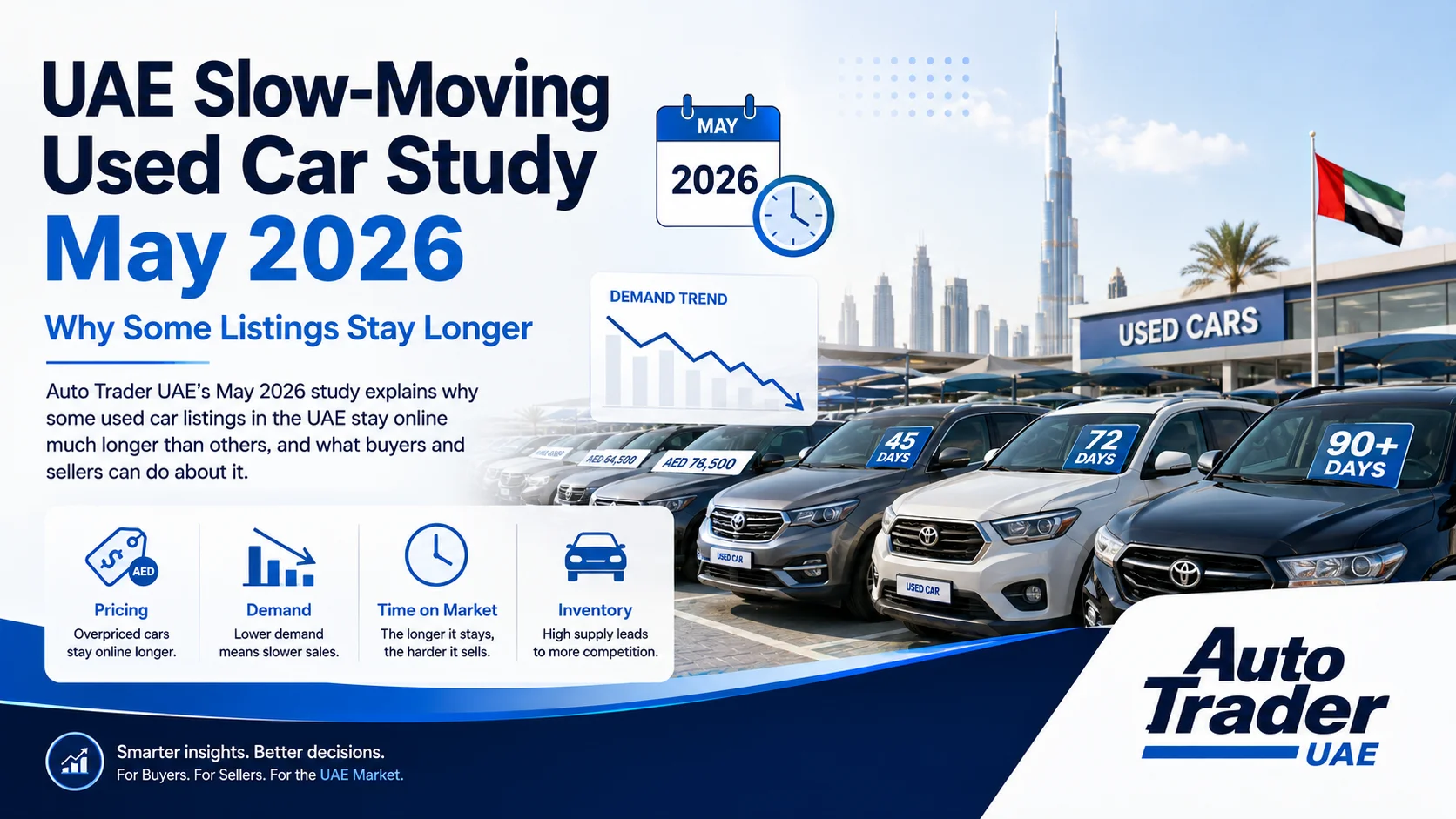
The UAE used car market remains highly liquid in 2026, with many popular models trading hands quickly as residents upgrade, downsize, or shift between petrol, hybrid and electric options. Yet a noticeable segment of listings is sitting online for much longer than the market average. This May 2026 market study from Auto Trader UAE looks at slow-moving used car listings – the vehicles that stay on the platform significantly longer than comparable cars – and explains what is driving these delays.
- Understand which types of cars tend to be overpriced or hard to shift – and where negotiation power is strongest.
- Spot good-value slow movers: clean, well-maintained cars that are only stuck because of pricing or weak adverts.
- Use days-on-market and spec patterns to prioritise which cars to inspect first.
- See why certain body types, trims and engine options are taking longer to sell in the UAE.
- Adjust your pricing, photography and description strategy to avoid becoming a slow-moving listing.
- Benchmark your car against faster-selling alternatives in the same segment.
- Generally faster movers in 2026: Toyota Prado used in UAE, Nissan Patrol used in Dubai, Hyundai Tucson used in UAE, Toyota Corolla used in UAE.
- More exposed to slow-moving behaviour: high-spec V8 SUVs, niche luxury coupes, older large sedans, early-generation EVs without fast-charging support.
Methodology
This May 2026 study is based on Auto Trader UAE listing data and observed market behaviour rather than a fixed statistical sample. To keep the analysis realistic and robust, we focused on directional trends rather than exact percentages. Key steps included:
- Review of listing durations for mainstream models across segments (hatchback, sedan, crossover, سيارة SUV, pickup, EV).
- Comparison between cars that attracted quick enquiries and those that required extended time on site or repeated re-listing.
- Qualitative review of price positioning versus apparent condition, mileage and service history.
- Cross-check of macro context such as fuel prices, registration policies and EV infrastructure.
- Auto Trader UAE internal listing behaviour, days-on-market patterns, and enquiry volumes.
- Public information from Dubai’s Roads and Transport Authority (RTA) on vehicle registration trends and regulations.
- Broader economic and population indicators from the Dubai Statistics Center.
- Monthly UAE fuel price announcements from the official fuel price committee and major fuel distributors.
- EV charging network updates and guidance from DEWA and national transport and interior authorities such as the UAE Ministry of Interior.
These signals were interpreted alongside live market inventory such as used cars in UAE and city-level pages like used cars in Dubai to ensure findings match real buyer and seller behaviour.
Key Findings
- 1. Overpriced popular models are now among the slowest movers
The UAE’s favourite nameplates – especially large SUVs and reliable Japanese sedans – still attract high demand, but unrealistic pricing is increasingly leaving them stuck online.
Instead of every used Toyota Prado for sale in UAE selling instantly, we now see clear separation: competitively priced cars with documented history move quickly, while similar vehicles priced noticeably above the market tend to linger.
Model examples: Toyota Prado, Nissan Patrol in Dubai, Range Rover used in UAE. - 2. High-consumption V8 SUVs and big sedans feel the impact of fuel costs
With regulated fuel prices in the UAE adjusting monthly, shoppers have become more fuel-cost aware. Very large-displacement petrol cars – especially older V8 SUVs and full-size sedans – are taking longer to move unless priced aggressively or converted to fleet/driver use.
Buyers looking at these vehicles often compare them to more efficient crossovers or newer turbocharged six‑cylinders, making them highly sensitive to even small price differences.
Model examples: older-model Nissan Patrol V8, Toyota Land Cruiser V8, Mercedes‑Benz S‑Class 500/600, Lexus LX V8. - 3. Niche body styles and low-demand trims are structurally slower
Certain formats appeal to a narrow audience and therefore naturally take longer to sell, regardless of overall market health. Two-door coupes, high-performance convertibles and very basic entry-level trims with manual gearboxes remain slow movers.
Similarly, luxury models with unusual colour combinations or heavily personalised interiors are often overlooked, even when well maintained.
Model examples: BMW 4 Series coupe, Audi TT, Ford Mustang convertible, basic-spec compact sedans with manual transmission. - 4. Early EVs and plug‑in hybrids are under pressure from newer tech
As DEWA and other entities expand public charging infrastructure and newer EVs arrive with better range and faster charging, early-generation EVs and plug‑in hybrids are becoming slower to sell.
Shoppers in Dubai, Abu Dhabi and Sharjah increasingly benchmark range, charging time, and warranty coverage when browsing EV listings. Earlier-imported models with limited range or no GCC warranty are more likely to stay on the platform longer unless priced clearly below newer rivals.
Model examples: first-generation Nissan Leaf, early BMW i3, older import Tesla Model S without regional support, legacy plug‑in hybrids from premium brands. - 5. Incomplete adverts are punished: weak photos and missing history delay sales
Across all segments, listings with poor-quality photos, no service history details and vague descriptions consistently stay online longer than well-prepared adverts at similar prices.
In a market where many buyers browse from their phone and shortlist quickly, clean images and documented maintenance make a clear difference. This is visible in everything from a family Hyundai Tucson to premium German SUVs.
Model examples: Hyundai Tucson, Kia Sportage, BMW X5 used in UAE, Mercedes‑Benz GLE. - 6. Mileage tolerance is rising, but only when price and service history align
With many residents commuting or driving between emirates, higher mileage on a car is less of a deal-breaker than before – provided the asking price reflects it and the service record is transparent.
Cars that are priced as “low mileage” when they clearly are not, or that show gaps in maintenance, tend to sit online. Conversely, honest high‑kilometre cars with dealer or specialist history and a realistic price often attract quick interest.
Model examples: high‑km Toyota Corolla and Camry, fleet‑used Mitsubishi Pajero, high‑mileage but well‑maintained Toyota Land Cruiser in Dubai. - 7. City versus inter‑emirate demand patterns matter
Slow‑moving behaviour can look different by city. Larger luxury SUVs and spacious sedans can be slower in central Dubai, where parking and fuel costs are felt more, but may move faster in Sharjah or Abu Dhabi where families value space and long‑distance comfort.
Similarly, compact sedans and crossovers that appeal to daily commuters typically rotate faster on city‑specific pages such as Dubai used cars, whereas more specialised models may take longer but eventually find buyers across emirates.
Buyer Takeaway
For buyers in the UAE, slow‑moving listings can represent both risk and opportunity. Where the real value often is Look closely at slow‑moving cars that are stuck for “fixable” reasons: weak photos, incomplete descriptions or slightly optimistic pricing. When you find a clean car with a sensible service history that has been on the market for a while, you typically have more room to negotiate. For example, a high‑spec Nissan X‑Trail used in UAE with average mileage and good maintenance that has stayed online longer than similar cars might simply be overpriced by a small margin. A constructive offer, backed by comparable listings, can unlock a good deal. Be cautious around structurally slow segments Conversely, be careful with the segments that are slow for structural reasons: very thirsty V8 SUVs, older luxury sedans and early‑generation EVs without clear service or battery history. In these cases, a long listing period may reflect limited long‑term demand, which could affect your own resale prospects. When considering such vehicles, compare them to more liquid alternatives:
- Compare an older V8 SUV against a newer V6 or turbo four‑cylinder crossover from brands such as Toyota, Nissan, Hyundai or Kia.
- Compare a niche luxury coupe to a more mainstream premium sedan or سيارة SUV that has clear demand in the UAE.
- Compare an early EV to newer models such as Tesla Model 3 used in UAE or Tesla Model Y used in UAE, and factor in charging access published by DEWA.
Use Auto Trader UAE tools When browsing used cars in UAE or used cars in Dubai, sort and filter by model year, mileage and price to see how a specific listing compares to others. Long‑listed cars standing out as clearly more expensive than similar options are natural candidates for negotiation.
Seller Takeaway
For private sellers and dealers, the key message of this study is that slow‑moving behaviour is increasingly driven by pricing discipline and listing quality, not just by the car itself. Price inside the realistic band, not at the dream number Buyers now have instant access to comparable offerings across the UAE. Pricing your car at the top of the market without clear justification (dealer warranty, full agency history, nearly new mileage) is the fastest way to become a slow mover. When listing a car such as a Prado, Patrol, Tucson or Corolla, study similar cars on Auto Trader UAE and position your price within a realistic band. A slightly sharper price can shorten your selling time far more than holding out for a higher, rarely accepted number. Invest in your advert High‑resolution photos taken in daylight, a clean car, and a truthful description with specifics (service intervals, major repairs, tyre age, accident history) all help move your listing out of the slow lane. Cars that need explanation – for example, imported EVs, modified performance models or vehicles with high mileage – should be presented transparently. Serious buyers in the UAE often appreciate honest disclosure more than vague claims of being in “perfect condition”. Be realistic about niche or high‑consumption models If you are selling a V8 SUV, big luxury sedan, niche coupe or early EV, expect a longer selling window and price accordingly from day one. Monitoring live inventory pages and adjusting quickly if your car is not attracting enquiries within the first couple of weeks can prevent your advert from going stale. Dealers operating across emirates can also consider re‑targeting stock between cities when demand is clearly stronger elsewhere – for example, moving family‑oriented SUVs into markets where larger households and inter‑emirate commuting are more common.
Conclusion
The May 2026 UAE Slow‑Moving Used Car Study shows a maturing market where buyers are better informed, fuel‑cost conscious and more selective about technology and running costs. Slow‑moving listings are no longer just “unlucky” cars; in many cases they reflect misaligned pricing, thin information, or structural demand limits. For buyers, this creates targeted opportunities to secure value on good cars that are stuck for fixable reasons. For sellers, it underlines the importance of realistic pricing, transparent history and professional‑looking adverts – especially for thirsty, niche or older‑tech vehicles. As the regulatory and economic backdrop continues to evolve, with guidance from bodies such as هيئة الطرق والمواصلات دبي, the Dubai Statistics Center, DEWA and the UAE Ministry of Interior, Auto Trader UAE will keep tracking how these shifts translate into on‑the‑ground listing behaviour. If you are planning your next move in the market, start by comparing real‑time inventory on used cars in UAE and explore city‑level deals on used cars in Dubai. Using these live benchmarks is the simplest way to avoid becoming – or overpaying for – the next slow‑moving listing.
For a closer view of how these market shifts are playing out, Browse used cars in UAE on Auto Trader UAE to compare live listings, prices, and current market activity more clearly.
Explore Live Inventory
- Browse used cars in UAE
- See used Toyota Land Cruiser listings
- See used Nissan Patrol listings
- See used Toyota Prado listings
- See used Toyota Corolla listings
- See used Tesla Model 3 listings
- See used Tesla Model Y listings
- See used Hyundai Tucson listings
- See used Kia Sportage listings
- See used Toyota RAV4 listings
- See used Nissan X-Trail listings
- Read more Auto Trader UAE market studies
Frequently asked questions about UAE Slow-Moving Used Car Study May 2026: Why Some Listings Stay Longer
Is UAE Slow-Moving Used Car Study May 2026: Why Some Listings Stay Longer a good choice for driving in Dubai and the UAE?
Yes, UAE Slow-Moving Used Car Study May 2026: Why Some Listings Stay Longer is well suited to Dubai and UAE conditions thanks to powerful air conditioning, smooth highway performance and a comfortable cabin that works well for long drives between emirates.
Is UAE Slow-Moving Used Car Study May 2026: Why Some Listings Stay Longer fuel efficient for daily use in Dubai?
Actual fuel efficiency for UAE Slow-Moving Used Car Study May 2026: Why Some Listings Stay Longer depends on traffic and driving style, but many Dubai buyers focus more on comfort and power. If you drive mostly on highways with smooth acceleration, you can keep the fuel consumption reasonable.
Is it easy to find used UAE Slow-Moving Used Car Study May 2026: Why Some Listings Stay Longer models in Dubai?
In Dubai you can usually find used UAE Slow-Moving Used Car Study May 2026: Why Some Listings Stay Longer listings from dealers and private sellers, especially in the luxury segment. Platforms like Auto Trader UAE make it easier to compare prices, mileage and specs for used examples.
What should I check before buying a used UAE Slow-Moving Used Car Study May 2026: Why Some Listings Stay Longer in the UAE?
Before buying a used UAE Slow-Moving Used Car Study May 2026: Why Some Listings Stay Longer in the UAE, check full service history, any accident or repaint records, suspension condition, tyre age, air-conditioning performance and electronics. A pre-purchase inspection is strongly recommended in the Dubai market.