
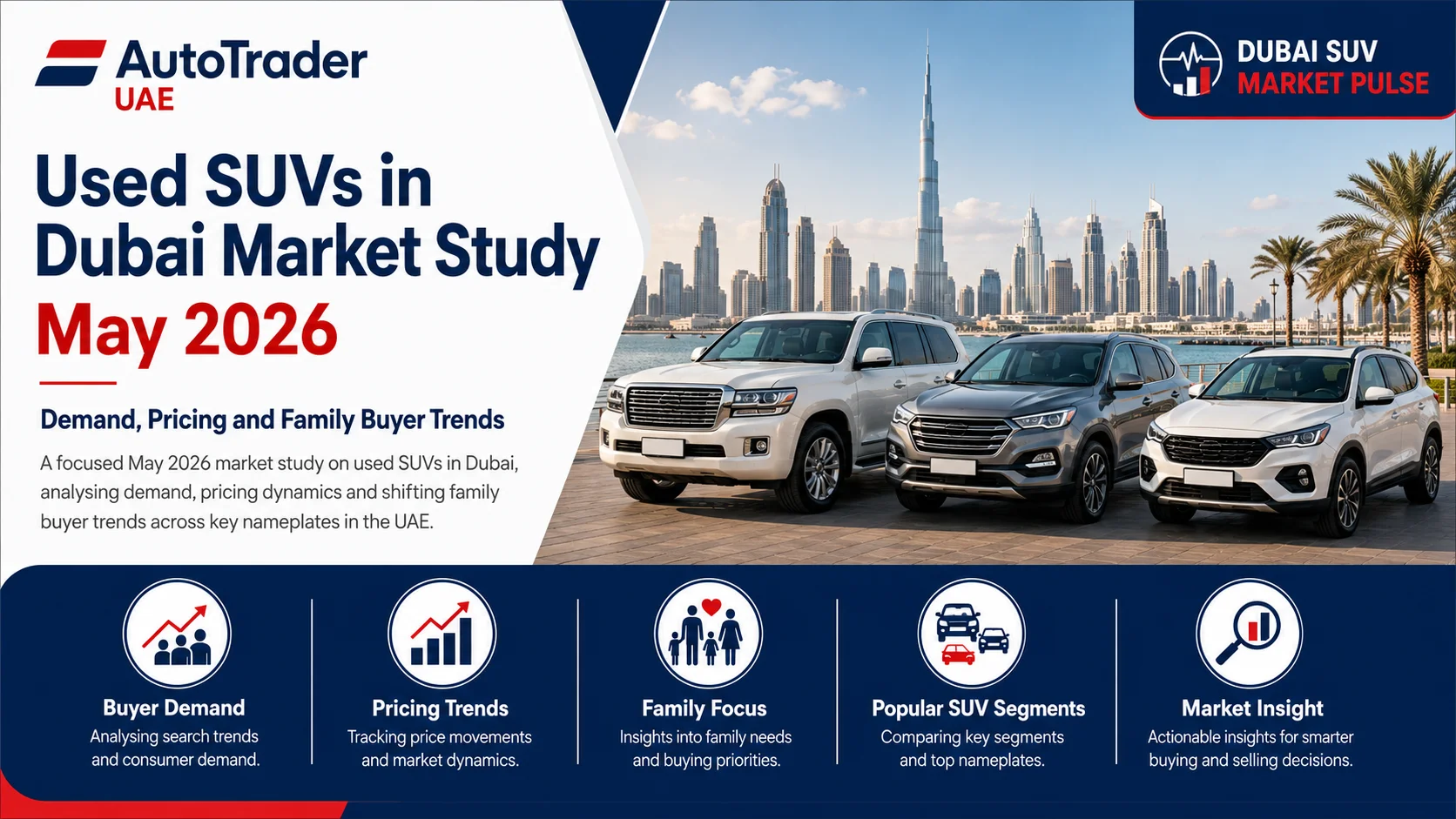
Overview
Dubai’s used SUV market in May 2026 remains one of the most active segments in the emirate’s pre-owned landscape. Family buyers, residents planning long-term stays, and ride‑hailing or corporate users continue to prioritise SUVs for space, comfort and perceived value stability. While the broader used car market shows signs of stabilisation after the post‑pandemic spike, demand for used SUVs in Dubai is still firm, particularly in the mid-size and full-size categories. Buyers are becoming more price‑sensitive and selective on specification, pushing sellers to adjust pricing and presentation to move stock efficiently.
• Strong interest in 3-row and mid-size SUVs with service history
• Noticeable shift towards 4‑cylinder petrol and hybrid options
• Growing acceptance of higher mileage if pricing and maintenance records are realistic
• Well‑specified, GCC‑spec SUVs with full history continue to sell fastest
• Overpriced base‑spec units are lingering online longer
• Professional listings with clear inspection notes are attracting more serious leads
• Toyota Land Cruiser & Toyota Prado – long‑term family and desert use
• Nissan Patrol – full‑size comfort with strong regional following
• Mitsubishi Pajero (late production years) – value 7‑seater option
• Hyundai Tucson & Kia Sportage – budget‑friendly crossovers
• BMW X5 & Mercedes‑Benz GLE – premium family movers
• Tesla Model Y – early adopter EV family SUV choice
Methodology
This May 2026 market study focuses on used SUVs traded in Dubai and nearby emirates with active cross‑emirate demand. The analysis is directional and based on aggregated signals rather than precise transaction statistics. Key inputs include:
- Listing and enquiry trends from used cars in Dubai and wider used cars in UAE on Auto Trader UAE, with emphasis on SUV body type and 2016–2023 model years.
- Visible pricing ranges for popular nameplates such as used Toyota Prado in Dubai, used Nissan Patrol in Dubai, and used BMW X5 in Dubai.
- Seasonal purchase behaviour observed ahead of summer travel, school holidays and registration renewal cycles.
- Macro signals from fuel price announcements and EV infrastructure expansion in the UAE.
- Publicly available market commentary and regulatory updates.
• Listing volumes and time‑on‑market for SUV body types on Auto Trader UAE
• Asking price bands by age, mileage and trim
• Buyer enquiry patterns for family‑oriented 5‑ and 7‑seater SUVs
• Relative interest in petrol, diesel, hybrid and EV SUVs
• Seasonal listing spikes before summer and year‑end
Relevant official references and context sources include:
- Dubai Roads & Transport Authority (RTA) – registration, licensing and vehicle standards
- Dubai Statistics Center – broader demographic and mobility indicators
- UAE Ministry of Energy & Infrastructure – fuel price announcements and infrastructure policy
- DEWA – EV Green Charger network and electrification trends
- UAE Ministry of Interior – federal traffic and safety frameworks
Key Findings
- 1. Family‑size SUVs remain the default for long‑term residents
Three‑row and roomy two‑row SUVs remain the natural choice for Dubai families balancing city driving with weekend trips. Buyers who have decided to stay in the UAE for several years are still leaning toward established nameplates with a strong GCC service footprint.
Notable examples: Toyota Land Cruiser, Toyota Prado, Nissan Patrol, and late‑model Mitsubishi Pajero. - 2. Pricing is stabilising, but buyers are pushing for value
After several years of elevated used values driven by new‑car supply constraints, asking prices in May 2026 show signs of rationalisation in many sub‑segments. Well‑maintained SUVs still command a premium, but buyers are more comfortable negotiating or shifting to slightly older model years to stay within budget. Price sensitivity is particularly visible in the mid-size crossover space.
Notable examples: 2018–2022 Hyundai Tucson, Kia Sportage, and Nissan X‑Trail. - 3. Spec and service history now matter more than year alone
Buyers comparing multiple used SUVs are weighting full dealer service history, GCC‑spec origin and key options (safety tech, panoramic roof, upgraded infotainment) more heavily than simply choosing the newest model year. Clean accident records and documented maintenance are proving decisive for many transactions.
Notable examples: Full‑history Toyota Fortuner, Honda CR‑V, and certified‑style premium SUVs such as BMW X5 and Mercedes‑Benz GLE. - 4. Shift toward efficient powertrains is gradual but visible
With fuel prices remaining a regular point of discussion, household buyers are increasingly evaluating fuel consumption and total running costs. Large V8 SUVs are still in demand for prestige and off‑road use, but a growing portion of family‑oriented buyers is considering smaller turbo‑petrol, V6, hybrid, and, in some cases, fully electric SUVs. Infrastructure updates from DEWA and government messaging around sustainability are supporting gradual acceptance of electrified SUVs rather than an abrupt shift.
Notable examples: Toyota hybrid SUVs (selected RAV4 and Highlander units), Lexus RX hybrids, early used Tesla Model Y units, and 4‑cylinder premium SUVs such as BMW X3 and Audi Q5. - 5. Premium SUV demand is selective, not soft
Interest in German and premium Japanese SUVs remains healthy, but the buyer profile is more informed than before. Shoppers are screening for ownership costs, focusing on cars with documented maintenance at reputable workshops or official dealers. Over‑equipped, under‑maintained units are harder to move, while sensibly specified examples at realistic prices still change hands quickly.
Notable examples: BMW X5, Mercedes‑Benz GLE and GLC, Audi Q7, and Lexus LX. - 6. Time‑on‑market diverges sharply between prepared and unprepared listings
SUVs presented with clear photographs, recent RTA inspection, service invoices and realistic mileage explanations tend to attract immediate enquiries. In contrast, SUVs with vague descriptions, missing paperwork or obviously optimistic asking prices are spending longer online, sometimes requiring later price corrections. This gap is widening as buyers use filters and comparison tools more effectively on portals like Auto Trader UAE.
Notable examples: Prepared listings across used cars in Dubai, with visible inspection details, compared to similar models without supporting documentation. - 7. Inter‑emirate demand is supporting Dubai SUV stock
Dubai’s deep inventory of used SUVs is increasingly attracting buyers from Sharjah, Ajman and Abu Dhabi seeking specific trims or colour combinations. Cross‑emirate purchasing is helped by standardised federal regulations and online pre‑screening of cars before physical viewing.
Notable examples: Shoppers comparing listings between Dubai and used cars in Abu Dhabi or used cars in Sharjah for models like Prado, Patrol and Pajero.
Buyer Takeaway
For buyers entering the used SUV market in Dubai in May 2026, the environment is more balanced than in the previous two to three years. Choice is improving, and although headline prices are still elevated compared with pre‑2020 levels, there is more room to find value. Practical implications for buyers:
- Use competition to your advantage. With multiple similar SUVs available, especially in mid-size and family segments, take time to compare mileage, service records and equipment across listings on used cars in Dubai before committing.
- Prioritise history over minor cosmetic flaws. A mechanically sound SUV with full service history and a clean هيئة الطرق والمواصلات دبي report is generally a better long‑term choice than a cosmetically perfect but undocumented example.
- Match SUV size to real usage. Unless you regularly carry seven passengers or do serious off‑roading, consider efficient crossovers such as used Hyundai Tucson, Kia Sportage or Nissan X‑Trail, which can be easier to park and run.
- Assess total cost of ownership. Factor insurance, fuel, tyres and periodic maintenance into your budget, particularly for large V8 or premium SUVs. A slightly higher purchase price on a well‑maintained, efficient SUV can be cheaper over three to five years.
- Be realistic on age and mileage. Dubai’s highway‑heavy driving patterns mean higher annual mileage is common. A properly serviced SUV with higher but honest mileage can be a solid buy if priced accordingly.
Seller Takeaway
For private sellers and dealers, the May 2026 used SUV market in Dubai rewards transparency, correct pricing and professional presentation. Practical implications for sellers:
- Price against today’s market, not last year’s peak. Monitor similar live listings for your model year and mileage across used cars in Dubai. Overpricing by even a modest margin can push serious buyers toward competing stock.
- Prepare documentation before listing. Gather your service book, invoices, warranty details (if any) and recent هيئة الطرق والمواصلات دبي inspection results. Highlight these clearly in your Auto Trader UAE listing to differentiate your SUV.
- Invest in basic reconditioning. A fresh service, clean interior and minor cosmetic touch‑ups can materially improve first impressions and reduce negotiation pressure, particularly for popular family models like Prado, Patrol and Pajero.
- Lead with the right angles in your listing. Include wide, well‑lit exterior shots, 3‑row seating images where relevant and clear odometer photos. Buyers short‑list visually before they ever call.
- Be prepared to negotiate within a reasonable band. Buyers are informed and often compare multiple SUVs side‑by‑side. Setting a realistic asking price with a small negotiation margin tends to achieve faster, cleaner deals than inflating the sticker and waiting.
Conclusion
The May 2026 landscape for used SUVs in Dubai is characterised by steady demand, improved choice and more rational pricing behaviour on both sides of the market. Family and long‑term residents continue to anchor demand in the 5‑ and 7‑seater segments, while a gradual tilt toward more efficient and electrified SUVs is visible but not yet dominant. For buyers, this is a moment to make deliberate, well‑researched decisions rather than rushed purchases. For sellers, success increasingly depends on transparent documentation, realistic pricing and professional‑grade online listings. As the emirate continues to grow and mobility patterns evolve, the used SUV segment should remain a core pillar of Dubai’s pre‑owned market. Platforms like Auto Trader UAE make it easier to benchmark pricing, compare specifications and transact efficiently across the full spectrum of SUVs, from value crossovers to flagship off‑roaders. To explore the latest opportunities, start with nationwide used cars in UAE or go straight to the heart of the SUV market via used cars in Dubai on Auto Trader UAE.
For a closer view of how these market shifts are playing out, Browse used cars in UAE on Auto Trader UAE to compare live listings, prices, and current market activity more clearly.
Explore Live Inventory
- Browse used cars in UAE
- See used Toyota Land Cruiser listings
- See used Nissan Patrol listings
- See used Toyota Prado listings
- See used Toyota Corolla listings
- See used Tesla Model 3 listings
- See used Tesla Model Y listings
- See used Hyundai Tucson listings
- See used Kia Sportage listings
- See used Toyota RAV4 listings
- See used Nissan X-Trail listings
- Read more Auto Trader UAE market studies