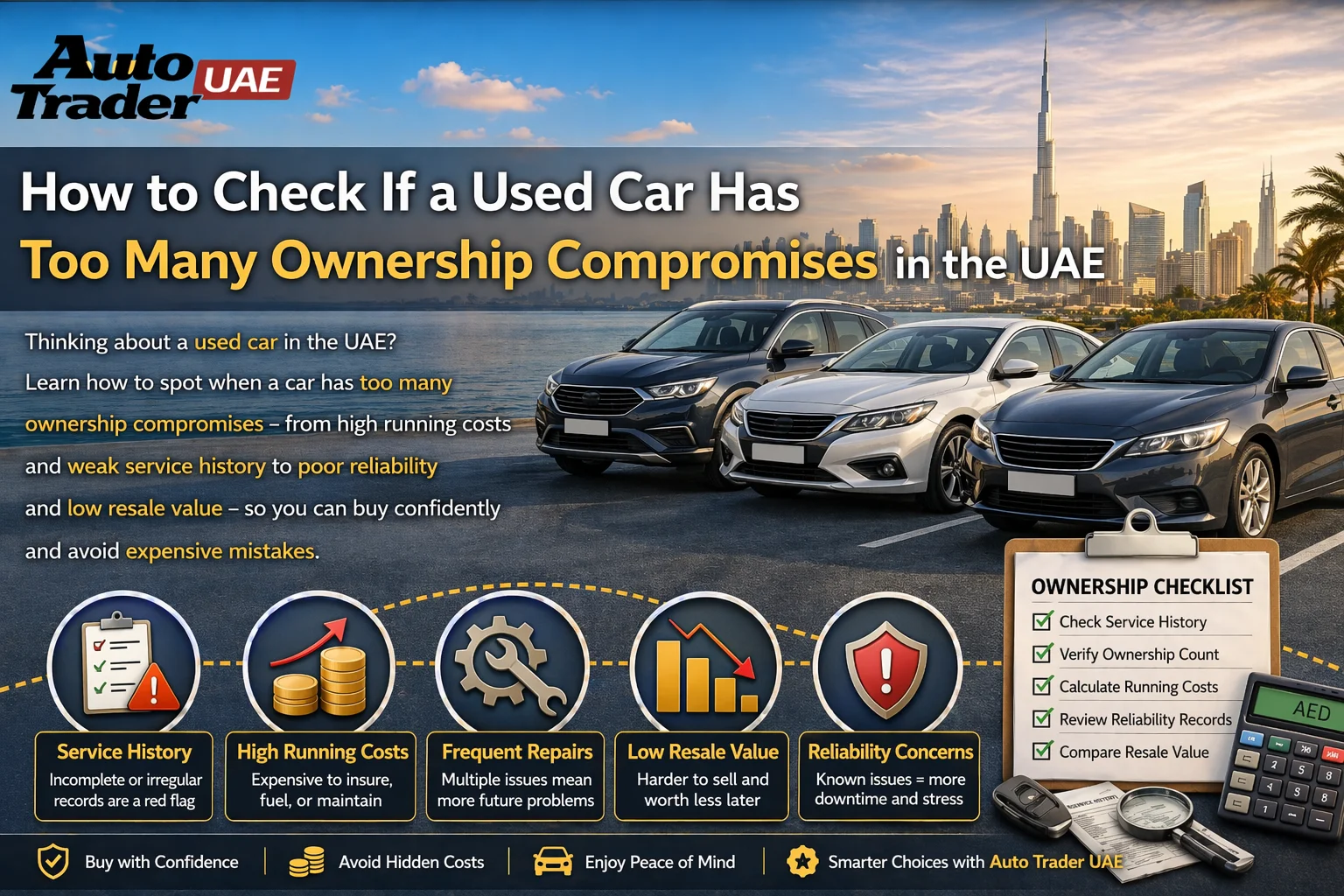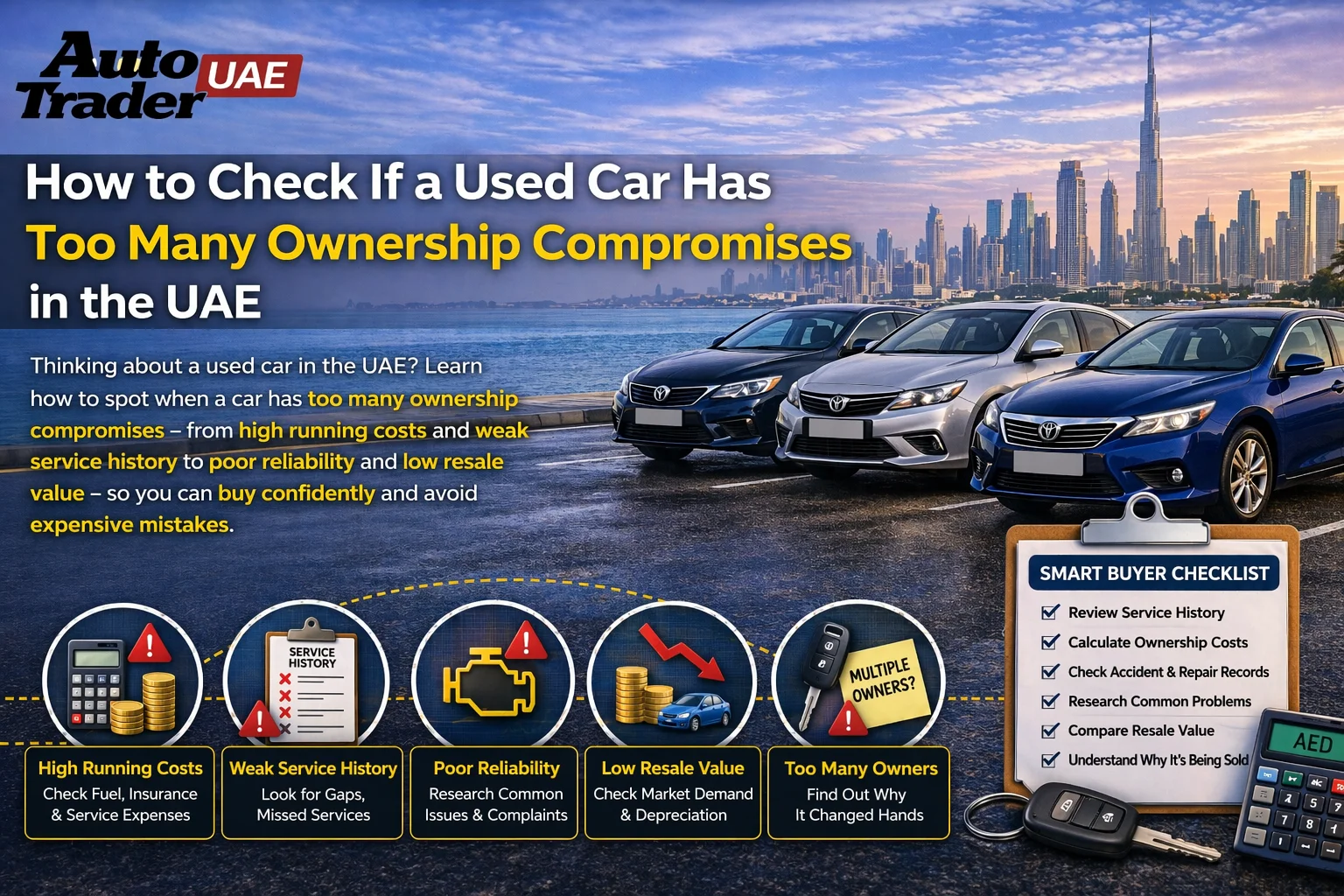
Buying used in the UAE can save you a lot of money, but some cars come with hidden compromises that make them expensive, stressful or unsafe to own. Knowing how to check if a used car has too many ownership compromises will help you avoid problem cars and choose one that suits your budget and lifestyle.
This guide from Auto Trader UAE focuses on what really matters for long-term ownership: running costs, maintenance, reliability, resale value, insurance and everyday practicality in UAE conditions.
1. Running Costs: Fuel, Tyres and Everyday Expenses
In the UAE, where many people drive long distances on highways and in city traffic, running costs add up quickly. A car that is cheap to buy can be expensive to run every month.
Check the fuel economy in real-world UAE use
- Search for real owner reviews (especially from GCC or hot-climate regions).
- Be cautious of powerful engines (V6, V8, turbo) if you mainly drive in city traffic.
- Ask the seller about their average fuel consumption and type of driving.
Red flags: The car needs premium fuel, drinks a full tank quickly in city driving, or owners frequently complain about high fuel bills.
Tyres, brakes and consumables
- Check the tyre size and brand fitted. Large, low-profile tyres are more expensive.
- Inspect tread depth and age (DOT code). Aged or worn tyres mean an immediate extra cost.
- Ask when the brake pads and discs were last changed and how much it cost.
Red flags: Oversized alloy wheels, unusual tyre sizes, or performance tyres that are costly to replace – especially on a budget car.
2. Maintenance Expectations and Service History
A used car in the UAE must have been serviced regularly to survive the heat, sand and stop-start traffic. A missing or weak service history is one of the clearest indicators of too many ownership compromises.
Always ask for documented service history
- Look for stamped service booklets or digital records from agencies and reputable workshops.
- Check that services were done on time (by mileage and year), not just occasionally.
- Confirm major services: timing belt/chain checks, transmission service, coolant changes and AC servicing.
Red flags: Gaps of more than a year, no proof of major services, or only vague verbal assurances like “always maintained”.
Understand typical maintenance costs for the model
- Search for parts prices and labour rates for the brand in the UAE.
- Check if there are many independent garages that know this model.
- Luxury brands (especially older ones) can have very high maintenance costs compared to their current market value.
If regular maintenance costs feel high for your budget, the car has a built-in ownership compromise that will only grow with time.
3. Reliability and Common Issues
Some models are known for long-term durability in the region; others struggle with AC, electronics or engine components under GCC conditions.
Research the model’s reliability record
- Look for GCC-specific forums, groups and reviews that mention common faults.
- Pay attention to issues related to overheating, AC failure or gearbox problems – all critical in the UAE.
- See if recalls were issued and whether they were properly completed.
Red flags: Repeated owner complaints about the same major problem, especially engine, transmission or AC issues, or long waits for parts.
Use a pre-purchase inspection
- Always get the car checked by a trusted independent workshop or inspection centre.
- Request a full diagnostic scan to reveal hidden fault codes.
- Inspect for oil leaks, coolant leaks, non-working electronics and weak AC performance.
Multiple mechanical warnings at inspection stage are a strong sign that this car will demand constant attention and money.
4. Resale Value and Market Demand in the UAE
Even if you plan to keep the car for years, resale value matters. A car with poor demand or a bad reputation in the UAE can be hard to sell or will lose value rapidly.
Check how easily similar cars sell
- Browse similar listings on Auto Trader UAE and note how long they stay advertised.
- Compare prices for different years and mileages to understand depreciation.
- See if the model appears frequently in “urgent sale” or heavily discounted ads.
Red flags: Very low prices compared with rivals, big gaps between asking prices and market averages, or many sellers struggling to find buyers.
Consider specification and origin
- GCC spec cars are generally preferred over imported US/Japan/European specs for local conditions.
- Unpopular colours, unusual options and rare trims can hurt resale.
- Heavily modified cars (tuning, suspension, body kits) often put off regular buyers and insurers.
If you are already worried about how you will sell the car later, that’s an ownership compromise that may not be worth taking.
5. Insurance Costs and Risk Profile
Insurance is a big part of yearly ownership cost in the UAE, especially for younger drivers or high-value cars.
Get an insurance quote before committing
- Ask for quotes using the car’s exact details: year, trim, GCC/import, modifications.
- Provide your driving history honestly to get realistic pricing.
- Compare comprehensive cover vs third-party to see what fits your budget and risk level.
Red flags: Insurance premiums that feel uncomfortably high, or some insurers refusing comprehensive cover because of the car’s age, accident history, or modifications.
Check accident and claim history
- Ask for any available police report references and previous accident details.
- Inspect for non-original paint, panel gaps, overspray and welding marks.
- Verify if airbags, ABS and other safety systems are intact and functioning.
A car with a heavy accident past not only affects safety and resale, but can also raise insurance costs and make claims more complicated.
6. Day-to-Day Practicality in UAE Conditions
Even a reliable, low-cost car can be a bad choice if it does not suit your lifestyle or the UAE environment.
Space, comfort and temperature
- Check rear-seat and boot space for family, luggage or work equipment.
- Test the AC thoroughly – front and rear – on a hot day, not just early morning.
- Pay attention to seat comfort, driving position and visibility for daily commuting.
Red flags: Weak AC, cramped rear seats, difficult access for children or elderly passengers, or poor visibility for tight city parking.
Ground clearance and usage type
- If you regularly visit sandy areas, construction sites or poorly paved roads, low and delicate cars will suffer.
- Off-road styled SUVs without proper 4x4 systems still have limitations; understand them.
- Consider suspension comfort on rough surfaces like speed bumps and service roads.
If the car struggles with your daily routes, it will feel like a compromise every single day.
Make a simple checklist
Before deciding, answer these honestly:
- Can I comfortably afford fuel, insurance and maintenance every month?
- Is the car reliable enough that I won’t constantly worry about breakdowns?
- Is the AC strong and is the car safe for my family?
- Will I be able to sell this car later without a big struggle?
- Does this car truly fit my daily UAE driving (parking, commute, heat, trips)?
If you find yourself saying “I’ll manage somehow” or “I’ll fix it later” on too many points, this car likely has more compromises than you should accept.
8. Using Auto Trader UAE to Avoid High-Compromise Cars
On Auto Trader UAE, you can compare many used cars side by side to find the one with the lowest overall ownership compromises for your budget.
- Browse by budget and body type to find cars that match your fuel and maintenance expectations.
- Compare similar listings of the same model to understand fair pricing and resale trends.
- Filter for GCC-spec and full-service-history cars, which often have fewer long-term issues.
- Use our related articles and model guides to understand common problems, running costs and insurance expectations for specific makes and models.
Taking an extra hour to research on Auto Trader UAE and arranging a professional inspection can save you thousands of dirhams in future repairs and lost resale value.
Conclusion: Buy the Car, Not the Problems
Knowing how to check if a used car has too many ownership compromises is about being realistic and informed. Focus on:
- Total running and maintenance costs
- Proven reliability in UAE conditions
- Insurance affordability and accident history
- Resale value and market demand
- Day-to-day practicality for your lifestyle
If a car fails on several of these points, walk away and keep searching. The UAE used car market is large and diverse – there is almost always a better, more balanced option.
Start comparing smarter choices today on Auto Trader UAE, and use our listings, ownership guides and model pages to find a used car that works with you, not against you, for years to come.
Before deciding, browse used cars in Dubai and across the UAE on Auto Trader UAE to compare condition, mileage, pricing, and seller details for models that fit your ownership goals.
Related Links
Buyer Takeaway
When buying a used car in the UAE, focus on vehicle condition, service history, inspection quality, paperwork, and total running costs rather than price alone. Compare options carefully and choose the option that best matches your budget and real needs.
Seller Takeaway
If you are selling a used car in the UAE, present the service history clearly, price the vehicle realistically, and highlight condition, specification, and ownership strengths honestly. A well-prepared listing with accurate details usually attracts more serious buyers.