How to Choose a Used Car for Buyers Who Want Lower Insurance Cost in the UAE
In the UAE, many buyers focus on the price of the car and fuel economy, but forget that insurance is one of the biggest yearly costs of ownership. If you’re buying used, choosing the right car can make a noticeable difference to your premium for every year you own it.
This guide explains how insurers in the UAE typically look at cars, and how you can use that to choose a used car that is easier and cheaper to insure, while still being practical and reliable for daily life.
Why Insurance Cost Should Shape Your Used Car Choice
Motor insurance is mandatory in the UAE, so you can’t avoid it – but you can control it. Over five to seven years of ownership, even a difference of a few hundred dirhams per year adds up.
When comparing two similar used cars, always look at the total cost of ownership:
- Purchase price
- Insurance cost (every year)
- Fuel consumption
- Maintenance and repair costs
- Depreciation and resale value
Sometimes, a car that is slightly more expensive to buy can be the smarter choice if it is cheaper to insure and run over the long term.
How UAE Insurers Think About Your Car
Different insurance companies use different formulas, but most in the UAE consider similar factors when pricing your policy:
- Car value and age – higher value cars cost more to insure; very old cars may need third-party cover only.
- Brand and model – some brands are cheaper to repair, and some models have better claims histories.
- Engine size and performance – powerful, performance-focused cars usually attract higher premiums.
- Body type – large SUVs, coupes, sports cars and luxury sedans can be more expensive than small hatchbacks and compact sedans.
- Spare parts and repair costs – expensive or rare parts push premiums up.
- Safety and security features – modern safety systems and anti-theft devices can help reduce risk.
- Intended use – personal vs commercial use, expected mileage, and where the car is usually parked.
Understanding this helps you select a used car that insurers see as “low risk”, which usually means a lower premium for you.
1. Choose the Right Segment: Practical Over Flashy
If your priority is lower insurance, aim for categories that insurers generally view as safe, sensible everyday vehicles:
- Small hatchbacks – often the cheapest to insure and run, ideal for city driving and short commutes.
- Compact and mid-size sedans – a strong balance between comfort, safety and running costs.
- Compact crossovers – more popular in the UAE now; still usually cheaper to insure than large, heavy SUVs.
Cars that can be more expensive to insure typically include:
- High-performance sports cars and coupes
- Large, luxury SUVs
- High-end luxury sedans with complex technology
On Auto Trader UAE, you can quickly filter by body type (hatchback, sedan, crossover, SUV) to keep your search focused on the more insurance-friendly options.
2. Pay Attention to Engine Size and Power
Engine size and performance are major indicators of risk for insurers. In general:
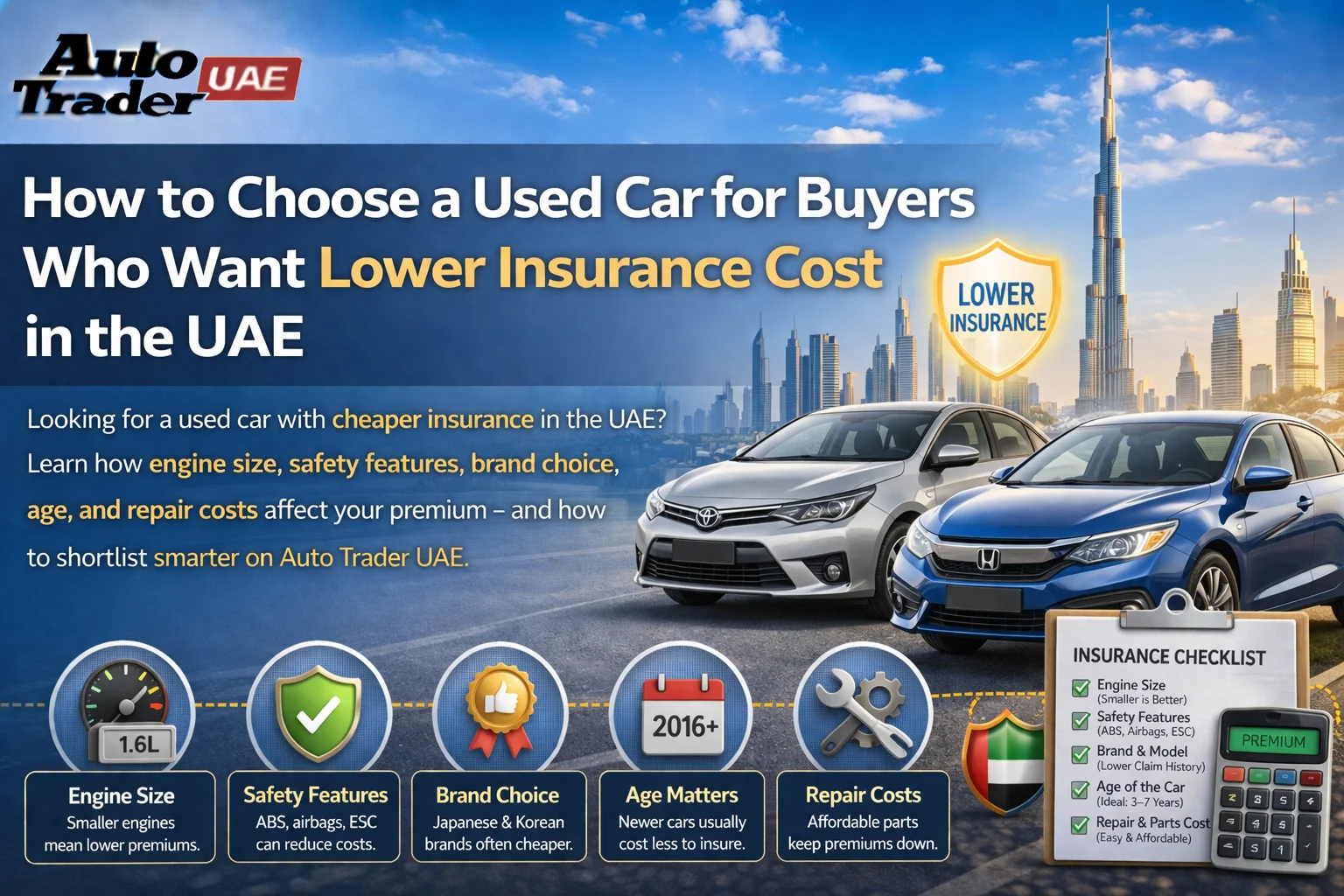
- Smaller engines (around 1.4L–2.0L) – often cheaper to insure and more fuel efficient.
- Turbocharged, high-output engines – even if the capacity is small, these can count as higher performance.
- Large engines (3.0L and above) – common in big SUVs and powerful sedans; usually more expensive to insure and fuel.
When comparing two used cars, check the exact engine size and power output in the listing. If you see a model offered with several engine options, the mid-range or smaller engine usually attracts the friendlier premium and better fuel economy, without sacrificing daily usability.
3. Consider Brand, Model and Parts Availability
Insurers look carefully at how easy and expensive a car is to repair in the UAE.
Factors that help reduce insurance costs:
- Brands with strong local presence – wide dealer networks and abundant spare parts.
- Popular models – widely used by families and commuters, with many parts available in the market.
- Simple, proven technology – fewer complex systems that can fail in an accident.
Factors that can increase your premium:
- Rare or niche models
- Imported specifications with unusual parts
- Exotic or high-end luxury brands
Before deciding, it’s smart to:
- Check service and maintenance costs for that specific model.
- Ask a trusted workshop about spare parts availability and pricing.
- Look at used car forums or owner groups in the UAE for real-world feedback on repair costs.
4. Age and Condition: Finding the Sweet Spot
With used cars, age is a balance:
- Very new (1–2 years old) – higher car value, so insurance is usually higher, but you get modern safety features and warranty coverage.
- Mid-age (3–7 years old) – often the sweet spot: good value, significant depreciation already done, and still modern enough for safety and comfort.
- Older vehicles (8+ years) – lower market value, but more potential for wear, and some insurers may limit you to third-party cover.
For long-term ownership and reasonable insurance, many UAE buyers find the 3–7-year range ideal, provided the car has a clear service history and has not been heavily damaged or modified.
5. Safety and Security Features That Can Help Your Premium
Insurers like cars that help avoid accidents and reduce injury. When comparing used cars, look for:
- Multiple airbags (front, side, curtain)
- ABS (anti-lock braking system)
- ESC/ESP (electronic stability control)
- Traction control
- Rear parking sensors and camera – very useful in tight UAE parking areas.
- Lane departure warning / blind-spot monitoring (on newer models)
- Immobiliser and alarm – reduces theft risk.
These features not only support your safety, they also reduce the chance of claims, which insurers consider when pricing your policy.
6. Avoid Modifications if You Want Lower Insurance
Many UAE cars, especially used imports, have aftermarket modifications. While some are cosmetic, others increase risk.
Insurers can load your premium for:
- Performance modifications (engine tuning, turbo upgrades, remapping)
- Suspension changes (lifted or lowered vehicles)
- Non-standard wheels and tyres outside factory specifications
- Body kits that change the car’s dimensions or crash behaviour
When your goal is a lower insurance cost, it’s often better to choose a car in original factory condition, with no significant performance or structural modifications. If a car is modified, declare it honestly to your insurer and obtain a proper quotation before you commit.
7. Reliability, Maintenance and How They Affect Insurance Over Time
While reliability does not change the premium directly, it affects your overall running costs and how long you can keep comprehensive cover sensibly.
To keep your total cost down over several years, focus on models known in the UAE for:
- Reliable engines and transmissions in high temperatures
- Simple, durable cooling systems – vital in UAE summers
- Strong air conditioning performance
- Reasonable service intervals and affordable parts
A car that is cheap to insure but constantly in the workshop is not a good deal. Use Auto Trader UAE’s listings and brand/model pages, and read buyer reviews and maintenance guides, to balance insurance cost with known reliability.
8. Resale Value and Depreciation in the UAE
If you plan to own the car for many years, depreciation matters as much as yearly insurance.
Cars that typically hold value better in the UAE are usually:
- From brands with strong service networks
- Popular with families and fleet buyers
- Known for reliability and affordable parts
- Equipped with features that most buyers want (automatic transmission, good AC, basic infotainment)
Stronger resale value means:
- You lose less money when you eventually sell or trade up.
- Comprehensive insurance might remain reasonable for longer, because the car retains a healthy market value.
On Auto Trader UAE, you can get a sense of resale strength by checking how many similar cars are listed, their asking prices, and how prices differ by model year and mileage.
9. UAE-Specific Practical Considerations
The UAE environment has its own demands. Alongside insurance, consider how well the car will cope with daily life here:
- Heat and sun – look for strong AC, good tint (legally compliant), and interiors that handle heat without rapid wear.
- Road conditions – if you regularly use unpaved roads, a compact crossover might be worth the slightly higher premium than a very low sedan.
- City vs long-distance driving – smaller cars work well in Dubai and Abu Dhabi traffic; for inter-emirate commuting, a comfortable sedan with good fuel economy is often ideal.
- Parking – narrow parking spaces in some buildings make a smaller footprint more practical and less prone to minor accidents.
10. How to Use Auto Trader UAE to Find Lower-Insurance Used Cars
You can make your search more efficient by using the tools and filters available on Auto Trader UAE:
- Filter by price – stay within a realistic budget, remembering that a slightly higher purchase price can be offset by lower yearly insurance.
- Filter by body type – focus on hatchbacks, compact sedans and crossovers if you want lower premiums.
- Check year and mileage – shortlist cars in that 3–7-year sweet spot where value and features balance out.
- Compare similar listings – view multiple examples of the same model to gauge market value, then ask insurers for sample quotes.
- Read descriptions carefully – look for mentions of accident history, modifications, and full service history.
For deeper research, you can also explore related articles on Auto Trader UAE about ownership costs, maintenance tips, and model-specific buyer guides to understand what long-term ownership will really cost you.
11. Get Insurance Quotes Before You Buy
A practical final step is to obtain provisional insurance quotes before committing to a car.
- Shortlist two or three used cars on Auto Trader UAE that you are serious about.
- Note their VIN/chassis number, year, trim, and engine size from the listings or seller.
- Contact two or three insurers or brokers in the UAE and ask for indicative quotes on each car.
- Compare not only the premium but also coverage details – excess, agency repairs, roadside assistance, and any add-ons you need.
This way, you don’t face surprises after paying for the car, and you can clearly see which option will be cheapest to insure over the years.
Conclusion: Balance Insurance Savings with Overall Value
Choosing a used car that is cheap to insure in the UAE is about more than just picking a small engine or a basic model. You need to balance:
- Insurance cost
- Reliability and maintenance
- Fuel consumption
- Safety and comfort
- Resale value
By aiming for a practical body type, sensible engine size, reputable brand, and strong safety features – and by avoiding risky modifications – you can enjoy lower premiums without sacrificing everyday usability.
When you’re ready to start shopping, use Auto Trader UAE to browse a wide range of used cars, compare real asking prices, and narrow down models that fit both your driving needs and your insurance budget. From there, a few quick insurance quotes will help you confirm which car truly offers the best long-term value for your money.
Before deciding, browse used cars in Dubai and across the UAE on Auto Trader UAE to compare condition, mileage, pricing, and seller details for models that fit your ownership goals.
Related Links
Buyer Takeaway
When buying a used car in the UAE, focus on vehicle condition, service history, inspection quality, paperwork, and total running costs rather than price alone. Compare options carefully and choose the option that best matches your budget and real needs.
Seller Takeaway
If you are selling a used car in the UAE, present the service history clearly, price the vehicle realistically, and highlight condition, specification, and ownership strengths honestly. A well-prepared listing with accurate details usually attracts more serious buyers.