
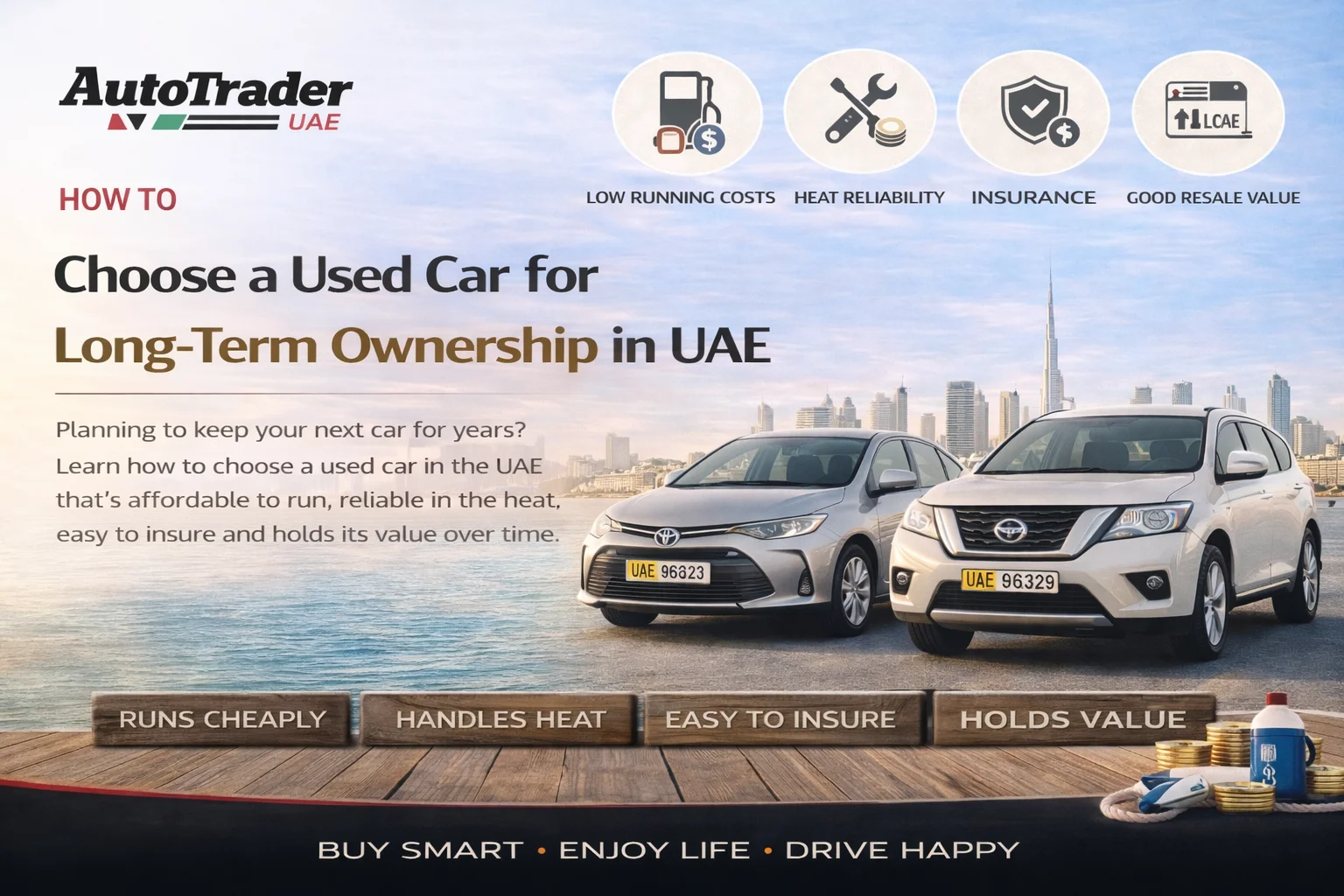
How to Choose a Used Car for Long-Term Ownership in UAE
If you plan to keep a car for 5–10 years in the UAE, choosing the right used car matters more than getting the lowest price today. The wrong choice can mean high fuel bills, constant breakdowns and poor resale value. The right car will be cheap to run, easy to maintain and still desirable when you’re ready to sell. This guide from Auto Trader UAE explains how to choose a used car for long-term ownership in the UAE, focusing on running costs, maintenance, reliability, insurance and daily practicality.
1. Start with a Clear Long-Term Budget
Most buyers focus on the purchase price. For long-term ownership, you should think in terms of total cost of ownership:
- Purchase price – what you pay now.
- Depreciation – how much value the car will lose while you own it.
- Fuel costs – especially important if you drive long distances.
- Maintenance and repairs – regular servicing plus unexpected work.
- Insurance – compulsory for the entire period you own the car.
- Registration, Salik and parking – smaller, but add up over years.
Before you start browsing used cars for sale, define:
- A realistic cash or finance budget for the purchase.
- A monthly amount you’re comfortable spending on fuel and maintenance.
- How many years you plan to keep the car.
Then search within that budget on platforms like Auto Trader UAE’s used car listings, filtering by price, year, mileage and fuel type.
2. Choose the Right Body Style for Daily Life in UAE
Your car needs to match your real usage, not just your dream usage.
- Small hatchbacks & sedans: Ideal for city driving, lower fuel use, easier to park and insure. Good for singles, couples or small families.
- Crossovers & compact SUVs: Higher seating position, better visibility, more space. Popular for families and school runs, often with reasonable running costs.
- Large SUVs & 4x4s: Great for desert trips, towing and big families, but higher fuel and tyre costs, and often higher insurance.
- MPVs / 7-seaters: Best if you truly need 6–7 seats regularly; otherwise they can be bulkier and costlier to run than needed.
For long-term ownership in the UAE, prioritise:
- Comfort in traffic – good AC, supportive seats, quiet cabin.
- Boot space – school bags, strollers, luggage, sports gear.
- Ease of parking – rear sensors or camera, reasonable length.
A car that fits your daily life will feel less tempting to replace early, making long-term ownership more realistic.
3. Focus on Reliability and Proven Durability
For long-term ownership, reliability is more important than gadgets. In UAE conditions—high heat, dust and heavy traffic—some factors matter more:
3.1. Favour simple, proven engines
- Non-turbo petrol engines are generally simpler, cheaper to maintain and more tolerant of heat than many small turbo engines.
- Overly complex features (air suspension, advanced off-road systems, complex infotainment) can be expensive to repair outside warranty.
3.2. Check regional reputation
Instead of relying only on global reviews, look at the car’s reputation in the UAE or GCC:
- Talk to local workshops and service centres.
- Read ownership reviews on regional automotive sites.
- Check how many similar cars appear repeatedly in classifieds with major issues mentioned.
Cars commonly used by taxis, fleets and delivery services are usually chosen for their durability and low running costs, which is a positive sign for long-term private ownership.
4. Understand Running Costs in the UAE
4.1. Fuel consumption
With daily commutes, school runs and weekend trips, fuel is a major cost over 5–10 years.
- Compare official fuel economy figures, but also look at real-world owner feedback.
- Moderate engines (e.g. 1.6L–2.0L petrol in compact cars, 2.0L–2.5L in midsize SUVs) often deliver the best balance between performance and economy.
- Very large engines and heavy 4x4s can become expensive if you drive long distances regularly.
4.2. Tyres, brakes and consumables
In our climate, tyres wear faster and may need replacement every 2–3 years depending on mileage and driving style.
- Check tyre sizes—larger, low-profile tyres are more expensive.
- Ask for a quotation from tyre shops for the specific size and brand.
- Consider the cost of brake pads, battery and AC servicing over time.
5. Maintenance and Parts Availability
A car that’s cheap to buy but expensive or difficult to maintain is not ideal for long-term ownership.
5.1. Service intervals and pricing
- Check the recommended service interval (for example, every 10,000 km).
- Ask a dealer or independent garage for approximate service package prices for that model.
- Factor in major services at higher mileage (e.g. timing belt, transmission service, coolant flush).
5.2. Spare parts availability
Look for models with strong presence in the UAE market:
- High sales volume usually means more available and cheaper parts.
- Many independent workshops can work on popular models, reducing labour costs.
- For rarer brands, parts may need to be ordered, increasing downtime and cost.
Before deciding, call a couple of reputable UAE workshops and ask about:
- Common issues with the model and their approximate repair costs.
- Availability of both original and high-quality aftermarket parts.
6. Transmission Choice: Automatic, CVT or Manual?
In the UAE, automatics dominate, and for long-term ownership you need something both durable and pleasant in traffic.
- Traditional automatic (torque converter): Generally robust when serviced on time. A safe option for many buyers.
- CVT (continuously variable transmission): Fuel-efficient and smooth, but sensitive to neglect. Check service history and avoid cars that have skipped transmission services.
- DCT / dual-clutch: Quick and efficient, but can be costly to repair if abused in stop–go traffic. Choose carefully and check history.
- Manual: Simple and durable but less common; resale can be harder in the UAE.
For a long-term, low-stress experience, a well-maintained conventional automatic or a proven CVT with complete service history is often the most practical choice.
7. Insurance Costs and Risk Profile
Insurance is compulsory and can be a significant yearly cost across 5–10 years.
7.1. Factors affecting your premium
Insurers in the UAE look at:
- Car value and age – more expensive or very new cars cost more to insure fully.
- Engine size and body type – powerful sports cars and large SUVs attract higher premiums.
- Safety features – more safety tech can help with rates.
- Driver profile – age, licence history, past claims, nationality and emirate of registration may all influence pricing.
7.2. How to estimate insurance before buying
Before committing to a used car, contact a couple of insurers or use online forms to get indicative quotes based on:
- Exact make, model, year and trim.
- Current value and your preferred coverage level (third-party vs comprehensive).
- Your expected annual mileage.
Add this yearly amount into your total ownership budget. Over multiple years, a car that is cheaper to insure can save a substantial sum.
8. Resale Value and Depreciation in the UAE
Even if you plan to keep the car for a long time, resale value still matters. Life changes—family, job moves, relocation—may force an earlier sale.
8.1. What helps resale value?
- Popular brands and models with strong used demand.
- Full documented service history, preferably at dealer or reputable specialists.
- Lower mileage compared to similar cars of the same year.
- Neutral colours like white, silver, grey and black.
- Accident-free status supported by inspection reports.
8.2. Model age sweet spot
For long-term ownership, many UAE buyers look for cars about 3–5 years old:
- Early heavy depreciation has already occurred.
- The car is still modern enough in safety and technology.
- With proper care, you can comfortably own it for another 5–7+ years.
Browsing Auto Trader UAE, you can compare asking prices by year and mileage to understand how different models hold their value.
9. Check Compatibility with UAE Climate and Use
Not every car is suited to our weather and driving patterns.
- Air conditioning: Test AC performance thoroughly. A weak AC can be a deal-breaker in UAE summers and costly to fix.
- Cooling system: Overheating history is a red flag. Check for coolant leaks, discoloured coolant or temperature warnings.
- Interior wear: Sun and heat can crack dashboards and fade upholstery. Good condition suggests careful previous ownership.
- Dust sealing: For desert or off-road use, check door seals and underbody condition.
If you plan occasional desert trips, consider a model with proper cooling, ground clearance and protection, but avoid heavy-duty off-road packages if you will rarely use them—they add weight, cost and complexity.
10. Ownership History and Documentation
For a car you’ll keep long-term, a clean, transparent history is crucial.
10.1. Key documents to verify
- Mulkiya (registration card) – confirms ownership, chassis number, engine size and year.
- Service book and invoices – check regular servicing at recommended intervals.
- Warranty records (if still active) – understand what’s covered and for how long.
- Accident or repair history – large repairs, major bodywork or airbag deployment should be evaluated carefully.
10.2. Number of owners and usage type
- Fewer owners with continuous service history is usually better.
- Ex-rental or fleet vehicles may have higher mileage but often have documented servicing—inspect them closely and compare pricing.
11. Pre-Purchase Inspection: Your Best Long-Term Insurance
Never skip a proper inspection, especially for a car you plan to keep for years.
11.1. Use a trusted independent inspector
- Choose a reputable inspection centre or mechanic, not connected to the seller.
- Request a comprehensive inspection covering engine, transmission, suspension, brakes, electronics, AC and bodywork.
11.2. What to pay special attention to
- Any signs of major accident damage or chassis repair.
- Oil leaks, coolant leaks or transmission fluid leaks.
- Warning lights on the dashboard.
- Unusual noises from the engine, gearbox or suspension.
- Uneven tyre wear suggesting alignment or suspension problems.
Use the inspection report to negotiate the price on Auto Trader UAE, or walk away from cars with serious issues. Losing one car is better than owning a headache for years.
12. Test Drive with Long-Term Use in Mind
Don’t just drive around the block. Use the test drive to imagine your daily routine.
- Start from cold and listen for rattles or rough idle.
- Test the AC at full power and check how quickly it cools the cabin.
- Drive at city speeds and highway speeds to feel stability and noise levels.
- Check parking ease: visibility, camera, sensors and steering weight.
- Try all electrical features: windows, locks, infotainment, lights, seat adjustment.
If something feels off during a short drive, it may become very annoying over years of daily use.
13. Plan Your Long-Term Maintenance Strategy
Once you buy the car, how you maintain it will determine its real long-term cost.
- Follow the service schedule without delay, especially oil changes.
- Use reputable workshops and quality parts, even if they cost slightly more.
- Keep all invoices and service records; they help both reliability and future resale on Auto Trader UAE.
- Fix small issues early before they develop into major repairs.
Many owners in the UAE extend the life of their cars well beyond 200,000 km with consistent maintenance. That’s where a smart used car choice really pays off.
14. Using Auto Trader UAE to Find the Right Long-Term Car
Auto Trader UAE can support every step of your search for a long-term used car:
- Browse thousands of used car listings across all major brands, body styles and budgets.
- Filter by year, mileage, fuel type, body style and price to match your long-term needs.
- Explore make and model pages to understand typical features and market positioning.
- Read ownership and buying guides to compare options for reliability, running costs and practicality.
You can also shortlist several candidates and compare:
- Average asking price for each model year.
- Mileage versus price to judge value for money.
- How many similar cars are on the market, which hints at resale demand.
Conclusion
Choosing a used car for long-term ownership in the UAE is about more than finding a good deal today. You’re choosing a partner for your daily life—school runs, commutes, road trips and everything in between. Focus on reliability, total running costs, insurance, serviceability, climate suitability and resale value. Always verify history, insist on a professional inspection and test drive thoroughly. Use Auto Trader UAE to research models, compare prices and find well-maintained used cars that fit your long-term needs and budget. With the right choice today and proper maintenance, you can enjoy years of trouble-free ownership and protect your investment when it’s time for your next car.
Before deciding, browse used cars in Dubai and across the UAE on Auto Trader UAE to compare condition, mileage, pricing, and seller details for models that fit your ownership goals.
Related Links
Buyer Takeaway
When buying a used car in the UAE, focus on vehicle condition, service history, inspection quality, paperwork, and total running costs rather than price alone. Compare options carefully and choose the option that best matches your budget and real needs.
Seller Takeaway
If you are selling a used car in the UAE, present the service history clearly, price the vehicle realistically, and highlight condition, specification, and ownership strengths honestly. A well-prepared listing with accurate details usually attracts more serious buyers.