
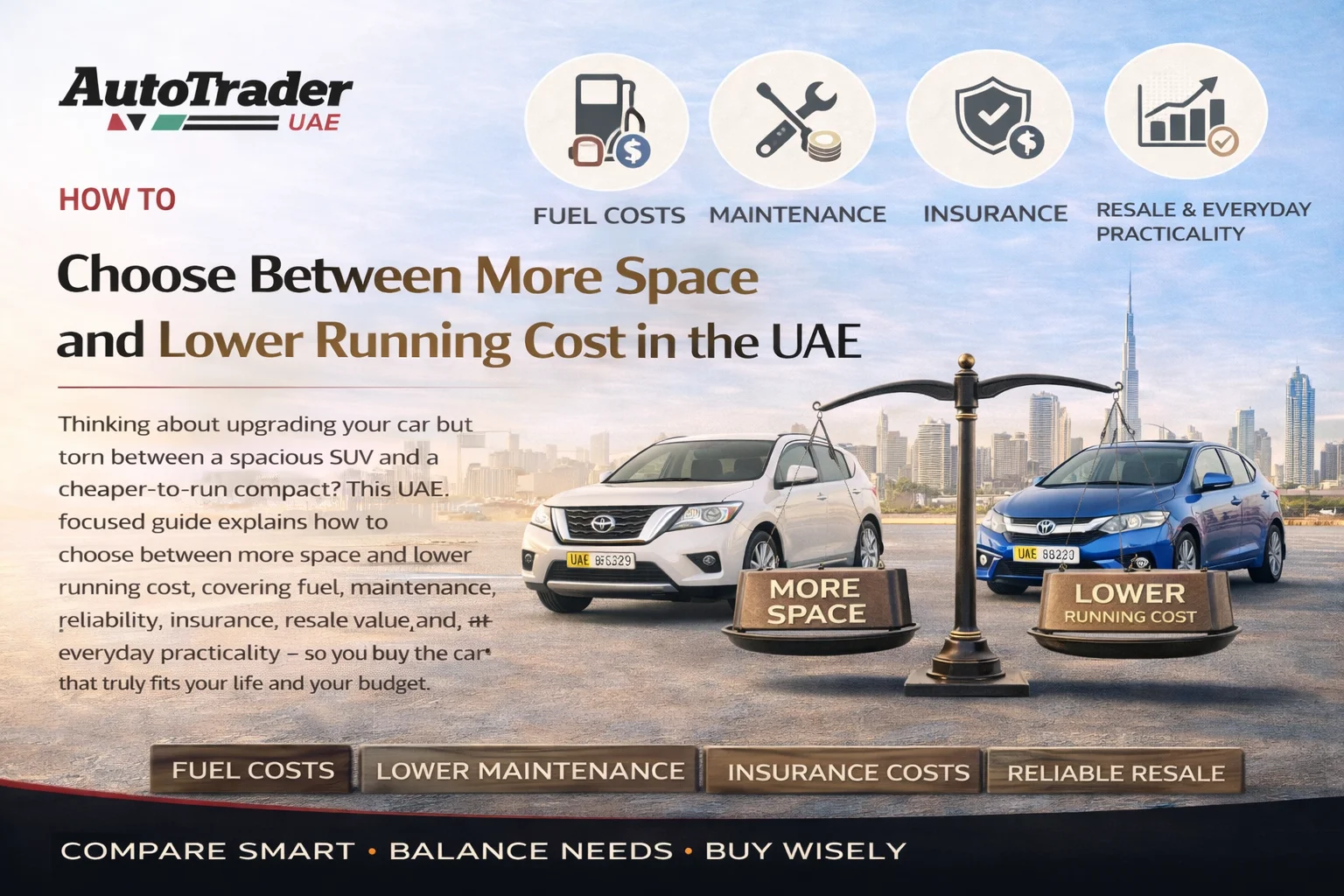
How to Choose Between More Space and Lower Running Cost in the UAE
In the UAE, many drivers face the same dilemma when shopping for a car: choose a bigger, more spacious vehicle for comfort and family needs, or a smaller car with lower running costs. Both options make sense, but the right choice depends on your lifestyle, budget, and how long you plan to keep the car.
This guide from Auto Trader UAE walks you through the key factors: fuel use, maintenance, insurance, reliability, resale value, and day-to-day practicality in local driving conditions.
1. Start with Your Real-Life Needs, Not Just Your Wishlist
Before comparing models, be brutally honest about how you use your car:
- Family size: How many people ride in the car daily? Do you often have guests or extended family with you?
- Cargo: Do you regularly carry strollers, sports equipment, tools, or luggage?
- Commute type: Mostly city driving, highway runs between emirates, or mixed use?
- Parking: Do you have tight parking at home or work, or easy access to wide spaces?
- Car ownership horizon: Planning to keep the car 2–3 years, or 5+ years?
If you only occasionally need extra space, you might be better off with a smaller, cheaper-to-run car and renting a bigger vehicle for rare family trips. If you constantly run short on seating or boot space, paying more to run a larger car can still be the smarter, less stressful choice long term.
2. How Vehicle Size Affects Running Costs in the UAE
In general, more space means a larger body, bigger engine, and higher cost of ownership. Here is how size typically changes your expenses:
2.1 Fuel consumption
Bigger vehicles are usually heavier and less aerodynamic, so they consume more fuel, especially in stop-start city traffic and with the A/C always on.
- Small hatchbacks & compact sedans: Ideal for daily commuting, fuel-efficient, and cheap to refuel.
- Crossovers & midsize SUVs: Moderate fuel use, often a good balance between space and cost.
- Large SUVs & MPVs: Higher fuel consumption, especially with larger engines and 4x4 systems.
In the UAE, petrol prices are relatively affordable compared with some countries, but if you drive long distances between emirates or use your car heavily for work, the difference between a fuel-efficient sedan and a large SUV adds up over time.
2.2 Scheduled maintenance
Larger vehicles and powerful engines usually mean:
- More expensive engine oil and larger filters
- Bigger, costlier tyres
- Higher labour time for some jobs
On the other hand, some spacious cars from mainstream Japanese and Korean brands have very straightforward service schedules and widely available parts, so they can still be affordable to maintain.
When browsing used cars on Auto Trader UAE, check the recommended service intervals and ask the seller or dealer about typical service bills for that specific model and engine size.
2.3 Parts and repairs
Replacement parts cost depends heavily on the brand and model, not just the size. However, bigger and more complex vehicles may have:
- More suspension components to wear out
- More electronics (powered seats, tailgates, extra climate zones)
- 4x4 systems and extra differentials that need servicing
If your goal is lower running cost, look for models with a simple mechanical setup and strong parts availability in the UAE. Auto Trader UAE’s make and model pages, plus owner-focused articles, can help highlight known reliability strengths and weaknesses.
3. Insurance Costs: How Space and Engine Size Affect Your Premium
In the UAE, car insurance premiums are influenced by:
- Vehicle value and age
- Engine capacity and performance
- Body style (SUV, sedan, coupe, etc.)
- Driver profile and claim history
Larger, more expensive SUVs or MPVs typically cost more to insure than a modest compact car, especially if they are newer and well-equipped. If you are comparing two vehicles on Auto Trader UAE, get insurance quotes for both before deciding. Over 4–5 years, the premium difference can match or exceed the cost of upgrading to a higher trim of a smaller car.
4. Reliability and Long-Term Ownership
Reliability is critical for both spacious and low-cost cars, especially if you plan to keep the vehicle beyond its warranty period.
4.1 Heat, traffic, and UAE conditions
Driving in the UAE means high temperatures most of the year, heavy A/C use, and often long highway journeys. When comparing space vs cost, consider:
- Cooling systems: Larger engines may run hotter; ensure the model is known for good cooling in hot climates.
- Transmission: CVT and dual-clutch gearboxes can be very efficient, but choose proven designs with good support in the UAE.
- Suspension durability: Big SUVs can handle rougher roads and occasional off-road, but city-only use might not justify the extra complexity.
4.2 Brand reputation and parts support
Some brands have an especially strong footprint in the UAE, meaning:
- Many independent workshops understand the cars well
- Aftermarket and genuine parts are widely stocked
- Resale is easier, whether the car is small or large
Check owner reviews and local forums and explore Auto Trader UAE listings to see which brands and models are most common. Common models often mean easier, cheaper long-term ownership.
5. Resale Value: How Size Affects What You Get Back
Resale value is a big part of your overall cost of ownership. In the UAE, both spacious SUVs and efficient compact cars can hold value well, depending on the brand and demand cycle.
5.1 When more space helps resale
Spacious vehicles tend to resell strongly when they meet popular needs:
- Seven-seat SUVs and MPVs for large families
- Mid-size crossovers with good fuel economy
- Reliable Japanese SUVs known for durability
5.2 When lower running cost boosts resale
Fuel-efficient, easy-to-park cars can be very attractive in the used market, especially in big cities:
- Compact sedans with modest engines
- Small crossovers that balance space and low fuel use
- Popular fleet and taxi models with proven reliability
Browse similar year and mileage cars on Auto Trader UAE to see how prices differ between large and small models from the same brand. This gives a realistic idea of how much money you may get back when you sell.
6. Day-to-Day Practicality: Comfort vs Cost
Beyond numbers, the choice between more space and lower running cost is about how the car feels to live with every day.
6.1 When more space is worth paying for
Choose a larger car if:
- You often travel with 4–7 people
- You frequently go on road trips between emirates
- You carry pushchairs, shopping, school bags, and luggage together
- You want a higher driving position and easier entry/exit for elderly parents
In these situations, the comfort and convenience of more space can easily justify higher fuel and insurance bills.
6.2 When a smaller, cheaper car is smarter
Choose a more efficient, compact car if:
- Your daily driving is mostly solo or with one passenger
- You drive mostly in city traffic and tight parking areas
- You prioritise low fuel bills, simple maintenance, and easy ownership
- You plan to change cars every 2–3 years and want wide resale appeal
7. How to Compare Total Cost of Ownership
To decide properly between space and running cost, compare the total cost of ownership for your shortlist:
- Shortlist 2–3 cars on Auto Trader UAE – for example, one compact sedan, one crossover, and one larger SUV.
- Estimate annual fuel cost:
- Check each car’s average fuel consumption (from manufacturer data or owner reports).
- Estimate your yearly kilometres (for many UAE drivers, 15,000–25,000 km is typical).
- Multiply by current fuel prices to estimate yearly spend.
- Check service and maintenance:
- Ask dealers or workshops for approximate service costs for each model.
- Consider tyres, brakes, and common wear items over 3–5 years.
- Get insurance quotes for each car with the same coverage level.
- Compare resale trends:
- Look at used listings for 3–5-year-old versions of those models on Auto Trader UAE.
- Note how much value they seem to retain.
Once you have these numbers, you can see whether the extra comfort of a bigger car is worth the additional cost per year compared with a smaller, cheaper-to-run model.
8. Matching Car Type to Your Ownership Strategy
Think about how long you keep cars and how you finance them:
8.1 Long-term owners (5+ years)
If you keep cars for a long time, focus on:
- Reliability: Proven models with strong records in the UAE
- Comfort and space: Enough room for your family’s future needs
- Affordable maintenance: Avoid overly complex or exotic vehicles
For long-term ownership, paying slightly more now for the right space and reliability can be more important than chasing the absolute lowest fuel use.
8.2 Short- to medium-term owners (2–4 years)
If you change cars often, consider:
- Resale appeal: Popular segments like compact sedans and crossovers
- Running cost: Low fuel and maintenance to keep total outlay down
- Warranty coverage: Buying within warranty period for peace of mind
In this case, a balanced car – not the largest or the smallest – often gives you both decent space and good running costs.
9. Practical Scenarios: Space vs Cost in Real Life
Scenario A: Young professional commuting daily
Daily solo commute from Sharjah to Dubai, weekend city use, limited parking at home.
- Best fit: Fuel-efficient sedan or small crossover.
- Why: Lower fuel, cheaper insurance, easier to park, still enough space for friends and shopping.
Scenario B: Growing family with two or three children
School runs, weekly mall trips, occasional road trips across emirates.
- Best fit: Midsize crossover or 7-seat SUV/MPV, depending on budget.
- Why: Extra seats and boot space make life easier, even if fuel and insurance are higher.
Scenario C: Business owner using car for work and family
Frequent site visits, carrying tools or samples, family duty in the evenings.
- Best fit: Practical SUV or pickup-based SUV with good reliability.
- Why: Space and durability matter more than minimal fuel bills, as the vehicle supports income generation.
10. Using Auto Trader UAE to Make the Right Choice
To find the right balance between more space and lower running cost:
- Browse used and new listings by body type (hatchback, sedan, SUV, MPV) to compare prices and running cost expectations.
- Use filters for engine size, fuel type, and mileage to shortlist efficient options.
- Read related ownership guides on Auto Trader UAE about insurance, maintenance, and reliability tips.
- Check model-specific pages to understand common pros and cons before you commit.
Conclusion
Choosing between more space and lower running cost is not just about the price at the pump. In the UAE, you should weigh fuel use, maintenance, insurance, resale value, and daily comfort together.
If you regularly carry family and luggage, a larger car can be worth the higher running costs for the comfort and flexibility it provides. If your driving is mostly solo city commuting, a smaller, more efficient car will likely save you money without sacrificing convenience.
Use the tools and listings on Auto Trader UAE to compare real cars side by side, estimate your total cost of ownership, and find the model that gives you exactly the space you need at a running cost you are comfortable with.
Before deciding, browse used cars in Dubai and across the UAE on Auto Trader UAE to compare condition, mileage, pricing, and seller details for models that fit your ownership goals.
Related Links
Buyer Takeaway
When buying a used car in the UAE, focus on vehicle condition, service history, inspection quality, paperwork, and total running costs rather than price alone. Compare options carefully and choose the option that best matches your budget and real needs.
Seller Takeaway
If you are selling a used car in the UAE, present the service history clearly, price the vehicle realistically, and highlight condition, specification, and ownership strengths honestly. A well-prepared listing with accurate details usually attracts more serious buyers.