
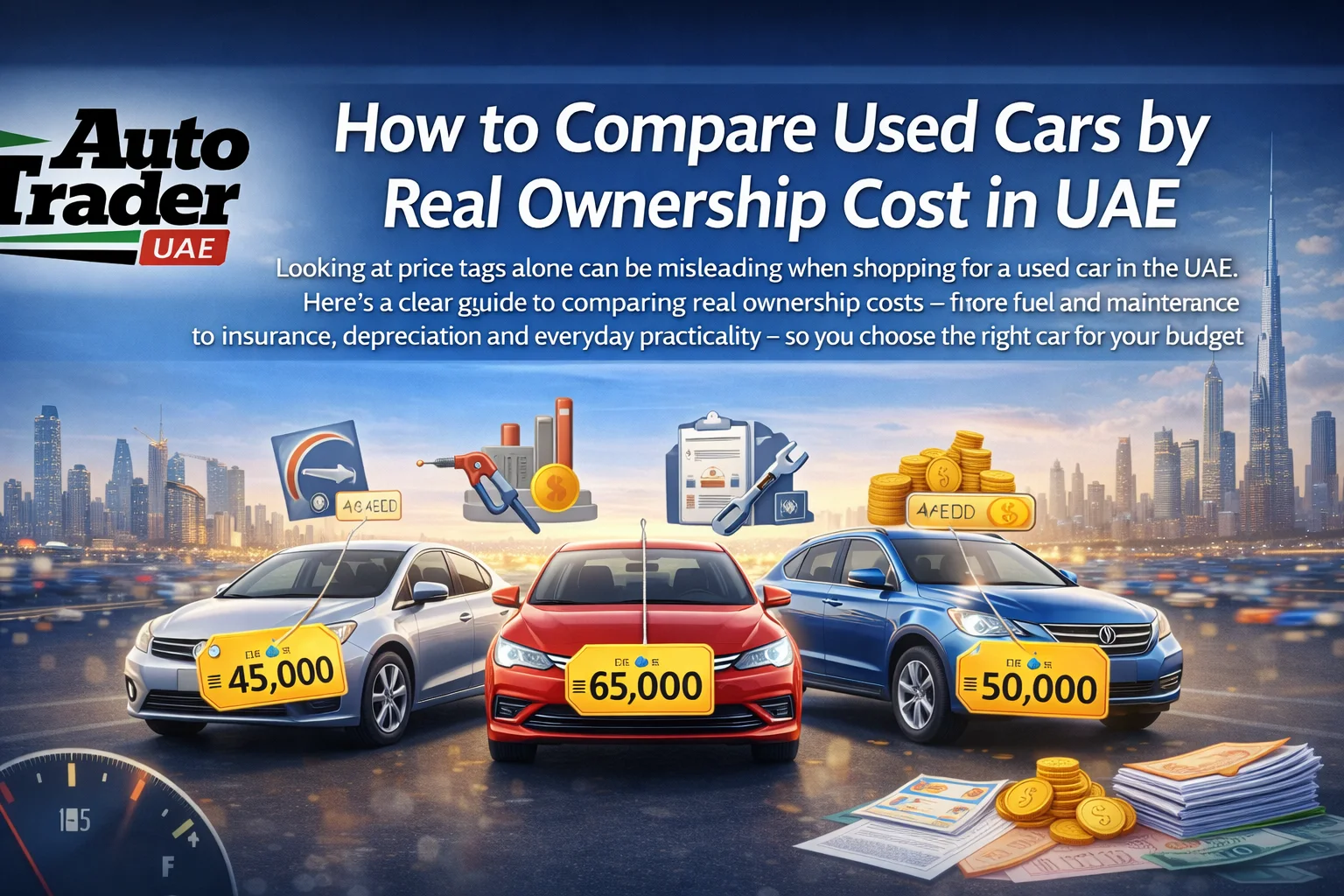
How to Compare Used Cars by Real Ownership Cost in UAE
In the UAE, two used cars with the same price can cost very different amounts to run over three to five years. To avoid surprises, you need to compare real ownership cost, not just the asking price.
This guide from Auto Trader UAE walks you through every major cost: fuel, maintenance, parts, insurance, registration, Salik and fines, depreciation and day-to-day practicality. Use it as a checklist while you browse used car listings, research specific brands and models, and read more ownership articles on our site.
Overview
Real ownership cost is the total amount you spend to use and keep a car over time. For buyers in the UAE, that usually includes:
- Purchase price (and any finance interest)
- Fuel and Salik tolls
- Routine servicing and wear-and-tear repairs
- Unexpected breakdowns
- Insurance and registration fees
- Parking, fines and regular washing/detailing
- Depreciation (how much value the car loses)
Instead of asking, “Can I afford this car today?”, a smarter question is, “How much will this car really cost me every year in the UAE?”. Once you look at cars this way, your shortlist often changes.
1. Start With a Clear Ownership Horizon
Your first step is to decide how long you expect to keep the car. In the UAE, most private buyers realistically keep a used car for:
- 3 years – common for expats with shorter contracts or people who like to upgrade regularly
- 5 years or more – common for families and cost-conscious owners
Your time horizon affects which costs matter more:
- 3-year horizon: Depreciation, finance interest, insurance and immediate maintenance matter most.
- 5+ year horizon: Long-term reliability, major service items (timing belt, gearbox service), parts availability and resale demand become critical.
Before you open any listing on Auto Trader UAE, decide: “I want a car that will be affordable to own for at least X years and roughly Y km per year.” Use that as your filter.
2. Fuel Economy and Daily Use in UAE Conditions
Fuel is one of the biggest running costs, especially if you commute between emirates or drive for work.
Estimate Your Annual Kilometres
Work out your approximate yearly distance:
- Daily commute (home to office and back)
- School runs
- Weekend trips and long-distance drives
Many UAE drivers fall between 15,000 and 30,000 km per year. If you are closer to 30,000 km, fuel economy should be a top priority.
Compare Fuel Consumption
When checking used car adverts, look for fuel consumption figures (L/100 km) or search the model on a trusted automotive site. As a rough guide:
- Small hatchbacks/saloon (1.4–1.8L): usually cheaper on fuel
- Mid-size SUVs (2.0–2.5L): moderate fuel cost
- Large SUVs (3.0L+), V6/V8: higher fuel bills, especially in city traffic
To compare two cars, use a simple yearly estimate:
- Find or estimate their fuel consumption (for example 7.5 L/100 km vs 12 L/100 km).
- Multiply by your annual km (say 20,000 km) and local fuel price.
You’ll often find that a more efficient car can save thousands of dirhams in fuel over several years, which might justify a slightly higher purchase price.
Consider Your Driving Style and Routes
In the UAE, heavy traffic in Dubai and Abu Dhabi, plus frequent stop‑start driving, often means real-world fuel use is worse than brochure numbers. If most of your driving is:
- City-based: smaller engines, hybrids and economical sedans are usually better.
- Highway between emirates: slightly larger engines can be comfortable without a huge fuel penalty.
- Off-road and desert use: expect higher fuel bills; compare fuel economy within capable 4x4 options, not against city cars.
3. Maintenance, Service History and Reliability
Maintenance is where many used-car owners in the UAE get caught out. A lower purchase price can quickly disappear in workshops if the car is unreliable or poorly maintained.
Check Service History Carefully
For every car on your shortlist, ask for:
- Stamped service book or dealer digital history
- Invoices for major services and repairs
- Evidence of timing belt / timing chain work (if applicable)
- Records of gearbox and differential oil changes (especially for SUVs and 4x4s)
A car with complete, verifiable service history – even if slightly more expensive – often has lower long-term ownership cost than a cheaper car with unknown history.
Research Common Issues and Reliability
Before you commit, search for common problems related to the car’s:
- Engine and gearbox (especially DSG/dual-clutch and CVT units)
- Cooling system (critical in UAE heat)
- Electronics and air conditioning
Use:
- Owner forums and online reviews
- Auto Trader UAE ownership and reliability articles
- Discussions with trusted independent garages
Reliable models with simple, proven engines and widely available parts reduce both unexpected breakdowns and time spent in workshops.
Understand Service Intervals and Costs
Service intervals vary by make and model (often 10,000–15,000 km), and some premium brands have higher labour and parts costs. To compare two cars, ask a reputable service centre for a rough quote for:
- Basic service (oil, filters, inspection)
- Major service (plugs, fluids, belts, etc.)
- Common wear items (brake pads/discs, suspension bushes, tyres)
Multiply that by how many services you’ll need over your planned ownership period. Include one or two unexpected repairs in your budget – older cars will rarely be trouble-free, even if they’re well maintained.
4. Parts Availability and Workshop Options
In the UAE, ownership cost is heavily influenced by how easy it is to find genuine and aftermarket parts and by the number of workshops familiar with the brand.
Brands with Strong Local Support
Brands with a big presence in the UAE and GCC often benefit from:
- Abundant original and aftermarket parts
- Competitive pricing due to high volumes
- Many independent specialists, not just dealer workshops
This usually means quicker repairs and lower bills. By contrast, niche brands or very new models can have more expensive or slower-to-arrive parts.
Compare Dealer vs Independent Servicing
For out-of-warranty used cars, many owners switch to trusted independent garages to lower costs. When comparing two cars, ask yourself:
- Are there good independent specialists for this brand in my emirate?
- Can I use quality non-genuine parts without major risk?
- Is the car still under any dealer or extended warranty, and what does that cover?
Even if one car is more complex, if there are strong independents and aftermarket parts, its long-term cost can be reasonable. A pre-purchase inspection by a third-party workshop is always a good investment.
5. Insurance, Registration and Annual Fees
Insurance cost in the UAE depends on several factors:
- Car value and age
- Engine size and body type
- Safety features (which can reduce risk)
- Your driving history and claim record
Get Real Quotes, Not Assumptions
Before choosing between two used cars, get actual insurance quotes using the car’s details (model year, trim, engine). A premium SUV or performance car may have significantly higher premiums than a compact sedan of similar age.
Also factor in:
- Registration and testing fees: Paid annually; similar within categories, but must be budgeted.
- Roadside assistance: Sometimes bundled with insurance or sold separately.
Over four or five years, insurance differences can equal several monthly instalments of a more economical car.
6. Depreciation and Resale Value in UAE
Depreciation is the value your car loses over time. In the UAE’s fast-moving market, it’s a critical part of real ownership cost – especially if you plan to sell within a few years.
How to Gauge Resale Value
To compare depreciation between two used cars:
- Look at current prices for the same model, 2–4 years older on Auto Trader UAE.
- Compare asking prices for similar mileage and condition.
- Check how many listings exist – a popular model with many listings and active demand is usually easier to sell.
Popular, fuel-efficient, and reliable models from well-known brands typically hold value better than thirsty or niche vehicles. Limited desirability means bigger discounts at resale time.
Consider UAE-Specific Factors
In this market, buyers often prefer:
- Cars with GCC specs and full documented service history
- Moderate mileage with proof of maintenance
- Non-modified, accident-free examples
When comparing real cost, a car with slightly higher mileage but perfect GCC history can be more attractive at resale than a lower-mileage import with uncertain background.
7. Day-to-Day Practicality and Hidden Costs
A car that doesn’t match your lifestyle will quietly cost you more – in fuel, time and even fines.
Size, Parking and City Use
Consider:
- Parking space: Large SUVs can be harder to park in tight city spots, leading to higher risk of minor damage.
- Building/area access: Some areas have limited parking or height restrictions.
- Daily manoeuvring: Smaller cars can reduce stress and time spent commuting and parking.
Comfort and Features for Your Routine
In the UAE climate, certain features are more than luxury; they save time and improve usability:
- Strong air conditioning and rear vents for family cars
- Remote start and ventilated seats (if within budget)
- Apple CarPlay/Android Auto for navigation and calls
A car that is comfortable and practical encourages you to keep it longer, spreading fixed costs over more years and reducing the urge for an early “upgrade”.
Salik, Tolls and Fines
Factor in your likely:
- Daily routes through Salik gates
- Parking zone costs near home and work
- Risk of speeding fines with more powerful cars
While these costs are not directly tied to the car itself, some vehicles (fast performance cars, for example) can make it easier to earn fines, adding to your annual outgoings.
8. Finance vs Cash: The Cost of Money
If you’re financing your used car through a bank or finance company, interest becomes part of your real ownership cost.
Compare Total Repayment, Not Just EMI
When choosing between two cars:
- Compare total amount payable over the loan term, including fees
- Note any differences in interest rate by car age or type
- Consider whether a smaller, more efficient car allows a shorter loan with less total interest
Sometimes, stretching to a more expensive model means higher insurance and interest, which might outweigh any savings in fuel or reliability.
9. A Simple Step-by-Step Comparison Method
To bring everything together, create a simple table for each car you’re considering. For a 3- or 5-year period, estimate:
- Purchase: Price + expected interest
- Fuel: Annual km × realistic fuel consumption × fuel price × years
- Servicing: Routine services (basic + major) + typical wear parts
- Repairs: A reasonable allowance for unexpected work (more for complex/older cars)
- Insurance & Fees: Annual insurance + registration/testing + roadside assistance × years
- Depreciation: Likely selling price at the end of ownership (using Auto Trader UAE prices) subtracted from your purchase price
This doesn’t need to be perfect; even a rough calculation will highlight which car is genuinely cheaper to own, not just cheaper to buy.
10. Using Auto Trader UAE to Research Real Ownership Cost
Auto Trader UAE is more than a place to browse used car listings; it’s also a tool to compare real-world costs:
- Use filters to shortlist cars that fit your budget, body type and fuel type.
- Open several listings of the same model to understand typical market pricing.
- Check description details for service history, warranty, and major work already done.
- Read related ownership and maintenance guides to understand expected running costs for different segments and brands.
- Visit brand and model pages to see common trims, engine sizes and features that affect cost.
The more you use real market data rather than assumptions, the more accurate your ownership cost comparison becomes.
Conclusion
Comparing used cars by real ownership cost in the UAE means looking beyond the price tag to understand fuel, maintenance, parts, insurance, depreciation and everyday practicality. When you add these elements together over your planned ownership period, the “cheapest” car on paper often isn’t the cheapest to live with.
Before you decide, build a simple cost picture for each car on your shortlist using real data from Auto Trader UAE listings, insurance quotes and workshop estimates. Then choose the car that fits both your lifestyle and your long-term budget.
Start exploring used cars for sale in the UAE today, and use our guides and model pages to understand running costs before you buy. A little research now can save you thousands of dirhams – and a lot of stress – over the years you own your next car.
Before deciding, browse used cars in Dubai and across the UAE on Auto Trader UAE to compare condition, mileage, pricing, and seller details for models that fit your ownership goals.
Related Links
Buyer Takeaway
When buying a used car in the UAE, focus on vehicle condition, service history, inspection quality, paperwork, and total running costs rather than price alone. Compare options carefully and choose the option that best matches your budget and real needs.
Seller Takeaway
If you are selling a used car in the UAE, present the service history clearly, price the vehicle realistically, and highlight condition, specification, and ownership strengths honestly. A well-prepared listing with accurate details usually attracts more serious buyers.