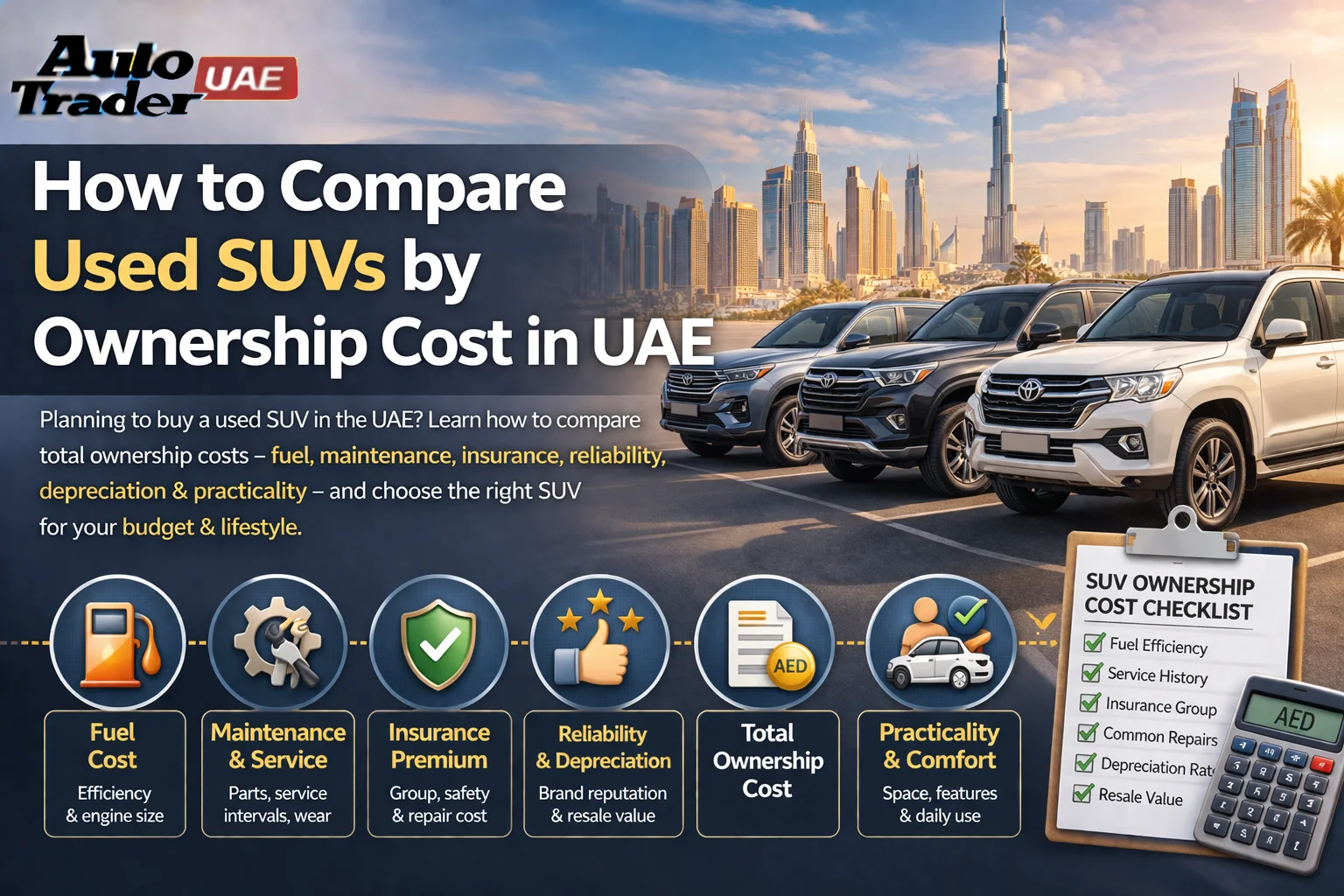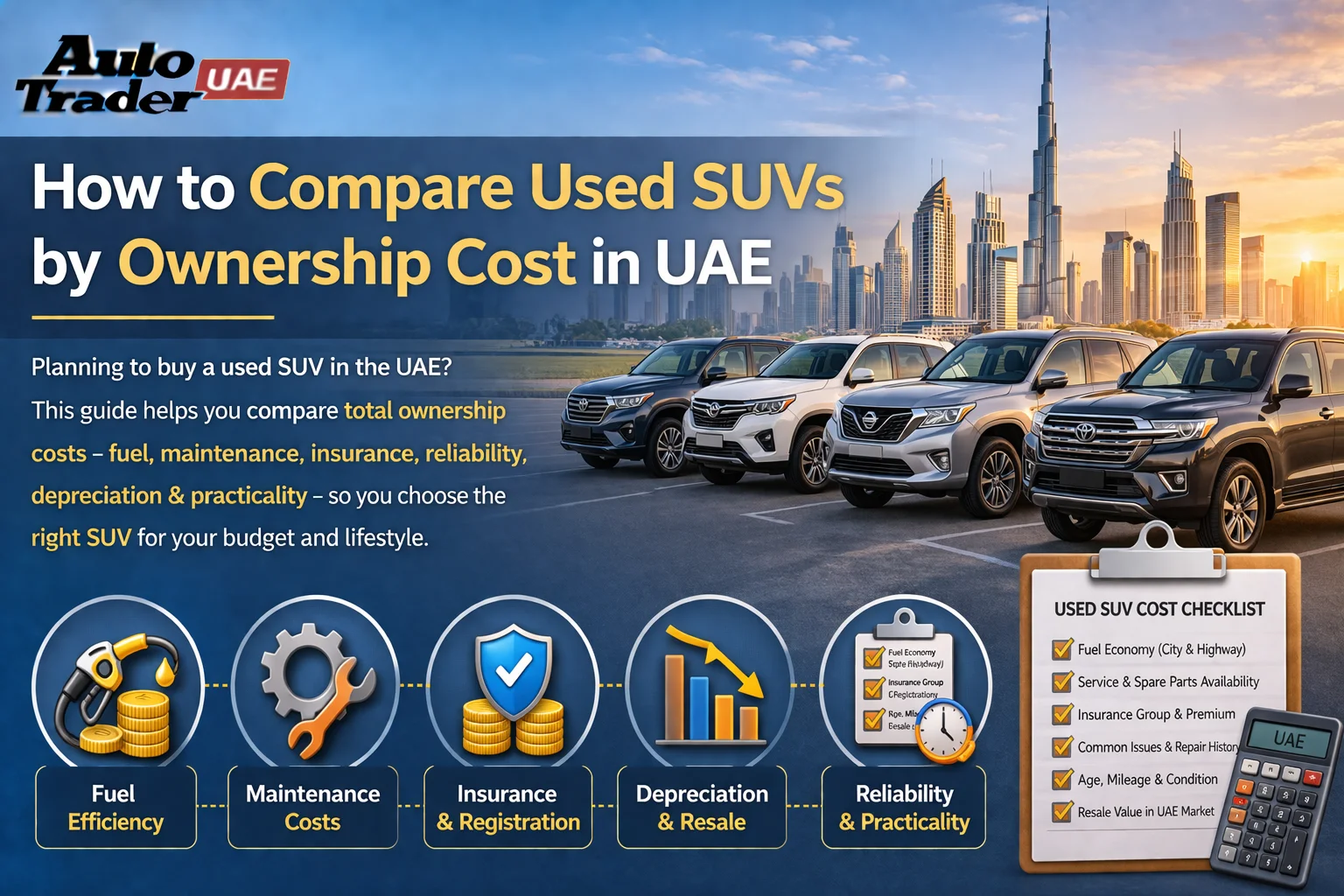
How to Compare Used SUVs by Ownership Cost in UAE
Buying a used SUV in the UAE is about more than the price on the windscreen. Two SUVs with the same asking price can have completely different ownership costs once you factor in fuel, maintenance, insurance, and resale value. This guide from Auto Trader UAE explains how to compare used SUVs by total cost of ownership, so you choose a car that fits your budget not just today, but for years ahead.
1. Start with Total Cost of Ownership, Not Just Price
When you compare used SUVs on Auto Trader UAE, don’t focus only on purchase price. Instead, estimate the total cost of ownership (TCO) over 3–5 years. For each SUV on your shortlist, consider:
- Purchase price (including any finance costs)
- Fuel costs (based on your real annual mileage)
- Routine servicing and scheduled maintenance
- Repairs and reliability risk
- Insurance premiums
- Tyres, brakes, and consumables
- Depreciation (how much value the SUV will lose)
- Registration, Salik, and parking where relevant
A slightly more expensive SUV with better fuel economy and stronger resale can work out cheaper than a low-priced SUV that is thirsty and costly to maintain.
2. Fuel Economy and Engine Size: How Thirsty Is It?
Fuel is one of the biggest running costs in the UAE, especially with larger SUVs used for commuting and school runs.
How to compare fuel costs
- Check official fuel economy figures (L/100 km or km/L) on manufacturer sites or trusted reviews.
- Consider your driving style: heavy traffic, short trips, and aggressive driving all increase consumption.
- Compare engine size and type: a 2.0–2.5L turbo can sometimes be more efficient than an older, naturally aspirated 3.5L engine.
Petrol vs diesel vs hybrid in the UAE
- Petrol SUVs are the most common and easiest to maintain.
- Diesel SUVs may offer better fuel economy, but check local servicing expertise and parts availability.
- Hybrid SUVs can reduce fuel costs, particularly in stop-start Dubai and Abu Dhabi traffic. However, check warranty coverage for hybrid components and battery condition.
If you drive 20,000+ km per year, even a small difference in L/100 km can equal thousands of dirhams over your ownership period.
3. Maintenance, Service History, and Parts Costs
Maintenance costs can turn a cheap used SUV into an expensive mistake. When browsing used SUV listings on Auto Trader UAE, pay close attention to service history and brand reputation.
Service history: what to look for
- Full service history (FSH) from dealer or reputable independent workshops.
- Stamped service book or digital records with invoices.
- Regular oil changes (ideally every 10,000 km or as per manufacturer schedule).
- Timely replacement of timing belt/chain, spark plugs, transmission oil, and coolant.
A complete history usually signals a careful owner and lowers your risk of expensive surprises.
Brand and model maintenance expectations
- Mainstream Japanese and many Korean SUVs are often cheaper to run thanks to strong parts availability and many independent workshops.
- European luxury SUVs can be more expensive for parts, diagnostics, and labour—especially for air suspension, complex electronics, and turbo setups.
- US SUVs may have good availability for popular models, but check specialist knowledge and parts pricing.
Always compare:
- Average service costs per year
- Cost of major wear items (brakes, suspension, air-con components)
- Availability of quality aftermarket or OEM parts in the UAE
A pre-purchase inspection at a trusted workshop is a smart investment and can reveal upcoming maintenance like tyres, brake pads, or engine leaks.
4. Reliability and Common Issues
Reliability affects both your wallet and your peace of mind. A used SUV that breaks down frequently will cost you in repairs, recovery, and lost time.
How to research reliability in the UAE
- Search UAE-based forums and owner groups for known issues with the model and engine.
- Read ownership reviews and long-term tests on automotive sites.
- Ask local workshops which SUVs they see most often for major repairs.
Typical SUV problem areas in this region include:
- Cooling systems struggling with extreme heat if not maintained properly.
- Air conditioning compressors and evaporators working extra hard in summer.
- Suspension components wearing faster if the car is used off-road or over speed bumps at speed.
- Electronics and sensors on older luxury SUVs.
When comparing SUVs on your shortlist, give extra value to models known for durability in hot-climate markets like the GCC.
5. Insurance: How the SUV Affects Your Premium
Insurance is a recurring cost that varies a lot between SUVs.
Key factors that influence insurance cost in the UAE
- Vehicle value: more expensive SUVs cost more to insure.
- Age of the car: newer SUVs may need comprehensive cover; older ones might allow third-party cover.
- Engine size and performance: powerful performance SUVs can attract higher premiums.
- Safety and security features: more safety tech can sometimes help with premiums.
- Your driving record and years of UAE licence.
Before committing to a used SUV, get at least two or three insurance quotes using the exact model, year, trim, and engine details. This will give you a more accurate idea of annual ownership cost.
6. Depreciation and Resale Value
In the UAE, depreciation is a major cost, especially if you plan to sell or upgrade within a few years.
How to gauge resale value
- Check prices of 3–7-year-old SUVs of the same model on Auto Trader UAE to see how well they hold value.
- Look for models with strong demand locally—these usually lose value more slowly.
- Prefer popular trims and engines over rare specifications that are harder to resell.
SUVs with a reputation for reliability, low running costs, and practicality tend to retain a larger share of their value. A strong resale value means your effective ownership cost is lower, even if the purchase price is slightly higher.
7. Tyres, Brakes, and Everyday Wear Items
Large SUVs use bigger, more expensive tyres and brake components. In UAE heat, these wear out faster, especially if you drive at higher speeds or frequently carry passengers and cargo.
Comparing these costs
- Tyre size: 18-inch tyres are usually cheaper than 20–22 inch performance tyres.
- Tyre type: off-road or all-terrain tyres cost more than standard road tyres.
- Brake parts: premium or performance brake systems are more expensive to replace.
When reviewing a used SUV listing, ask:
- When were the tyres last replaced?
- What brand and size are fitted?
- Have brake pads and discs been changed recently?
Including these items in your comparison will give you a more realistic picture of year‑one ownership cost.
8. Practicality, Comfort, and How You’ll Use the SUV
Total ownership cost is not only about money. An SUV that doesn’t suit your daily life can end up being more costly in time, stress, and wasted fuel.
Key practicality questions
- City use vs. long-distance: Will you mostly drive in Dubai/Abu Dhabi traffic or regularly go between emirates?
- Family needs: Do you truly need three rows of seats, or will a two-row SUV be enough and cheaper to run?
- Parking: Will a large SUV be difficult to park at home or work, increasing the risk of minor damage?
- Cargo space: Is the boot large enough for strollers, luggage, or sports gear?
- Off-road vs. on-road: Do you need real 4x4 capability, or will a front- or all-wheel-drive crossover be sufficient and more efficient?
Choosing an SUV that truly fits your daily routine can save fuel, reduce wear, and help you keep the car longer, which spreads your costs over more years.
9. Comparing Used SUVs Step by Step
Here’s a simple process you can follow using Auto Trader UAE:
- Set your budget for purchase and monthly running costs.
- Shortlist 3–5 used SUVs that match your space and usage needs.
- Check fuel economy and estimate annual fuel spend based on your mileage.
- Review service history in the listing and ask the seller for records.
- Research reliability for each model and any common issues in the UAE.
- Get insurance quotes for each shortlisted SUV.
- Check tyre size and estimate replacement cost; look at brakes and suspension in inspection.
- Compare current market prices for different model years to understand depreciation and future resale value.
- Arrange a pre-purchase inspection to confirm condition and upcoming maintenance needs.
- Test drive each SUV to assess comfort, practicality, and whether it fits your daily life.
Create a simple comparison table (even on paper or a spreadsheet) listing yearly fuel, insurance, service, and estimated depreciation for each SUV. This makes it clear which one is truly the most affordable to own.
10. How Auto Trader UAE Can Help You Choose Wisely
Auto Trader UAE makes it easier to compare used SUVs by ownership cost:
- Filter and search tools to narrow down SUVs by price, year, mileage, fuel type, and body style.
- Detailed listings where many sellers include service history, spec, and tyre/inspection information.
- Model pages and guides that help you understand common issues, running costs, and trim differences.
- Related ownership articles covering maintenance tips, insurance guides, and buying advice in the UAE market.
By combining these tools with the steps in this guide, you can compare used SUVs not just on price, but on what they will truly cost you to own.
Conclusion: Focus on Long-Term Value, Not Short-Term Savings
When you understand how to compare used SUVs by ownership cost in the UAE, you’re far less likely to be surprised by big bills later. Look beyond the initial price and evaluate fuel use, maintenance, reliability, insurance, depreciation, and everyday practicality. Use Auto Trader UAE to shortlist suitable SUVs, review real market prices, and connect with sellers. With careful research and a clear eye on total cost of ownership, you can find a used SUV that delivers the space, comfort, and capability you need—without stretching your budget year after year.
Before deciding, browse used cars in Dubai and across the UAE on Auto Trader UAE to compare condition, mileage, pricing, and seller details for models that fit your ownership goals.
Related Links
Buyer Takeaway
When buying a used car in the UAE, focus on vehicle condition, service history, inspection quality, paperwork, and total running costs rather than price alone. Compare options carefully and choose the option that best matches your budget and real needs.
Seller Takeaway
If you are selling a used car in the UAE, present the service history clearly, price the vehicle realistically, and highlight condition, specification, and ownership strengths honestly. A well-prepared listing with accurate details usually attracts more serious buyers.