
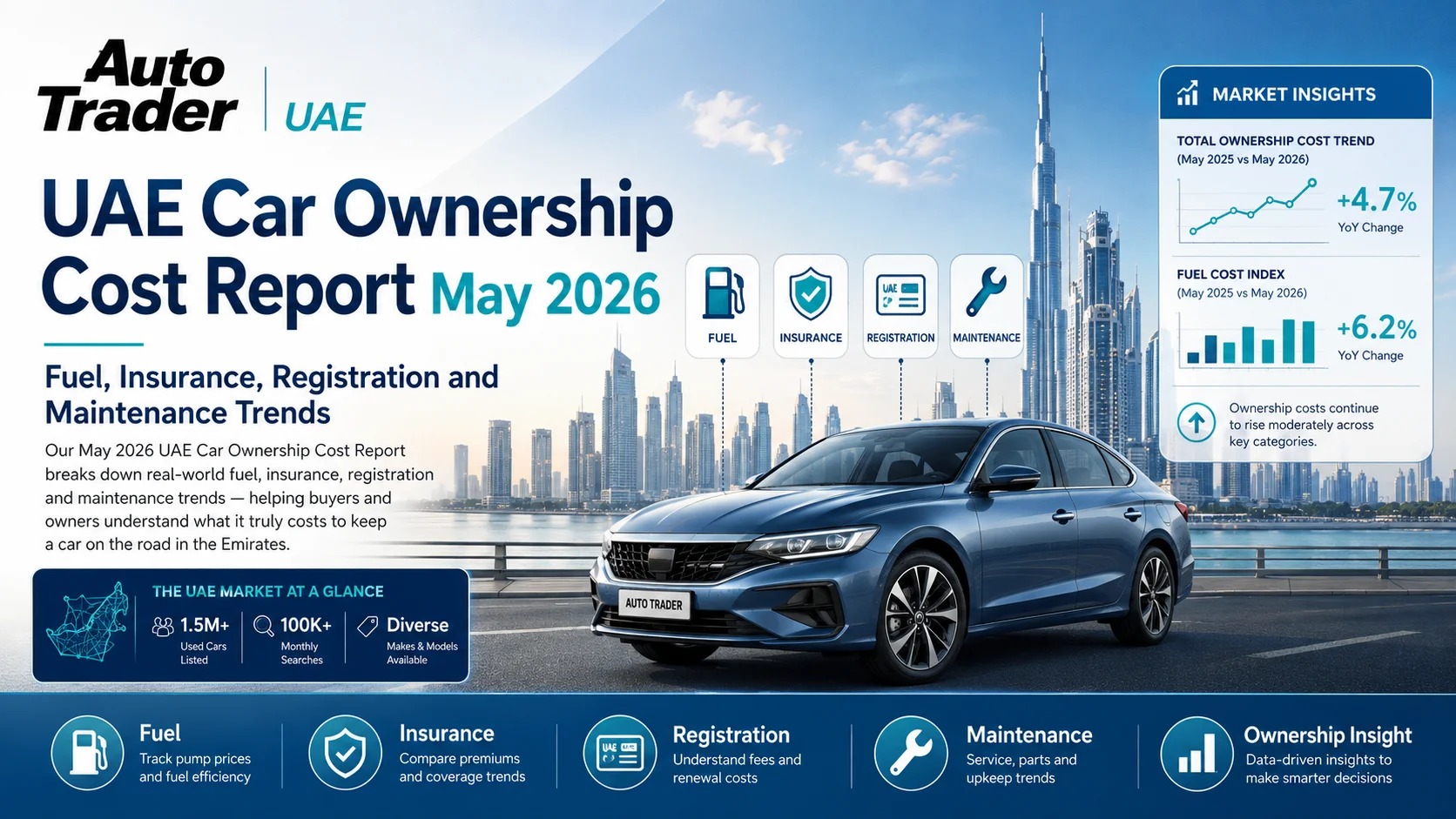
The UAE Car Ownership Cost Report May 2026: Fuel, Insurance, Registration and Maintenance Trends is designed to help everyday drivers, long-term expats and fleet buyers understand what it really costs to run a car in the Emirates today. Drawing on current market data, insurer insights and live listing trends on Auto Trader UAE, this guide focuses on the practical numbers that affect your wallet every month – not just the showroom price.
Overview
In May 2026, overall car ownership costs in the UAE remain competitive compared with many global markets, but the mix of expenses is shifting:
- Fuel prices are still relatively affordable in global terms, but smarter engine choices and hybrid powertrains now deliver clearer savings over three to five years.
- Insurance premiums have stabilised after previous post-pandemic swings, though luxury models and high-performance SUVs continue to attract higher rates.
- Registration and testing costs remain predictable, but owners need to budget carefully for add-ons like Salik tags, parking and fines.
- Maintenance is where many owners feel pressure, especially for older imported cars without local history or warranty.
This report focuses on the core running costs that matter most to UAE motorists: fuel, insurance, registration and maintenance – along with reliability and resale value trends that directly affect long-term cost of ownership.
Methodology
This May 2026 UAE car ownership cost overview is based on:
- Live listing trends on Auto Trader UAE across popular vehicle segments (small hatchbacks, compact sedans, midsize SUVs, large SUVs, pickups and EVs).
- Published pump prices from the UAE fuel price committee for early 2026 and typical annual mileage ranges (12,000–25,000 km) reported by owners.
- Market insights from UAE insurance providers and brokers on premium drivers: age, claims history, car type and vehicle value.
- Service menu pricing publicly available from major dealer groups and independent workshops, plus common parts costs for popular models.
- Regulatory fee structures publicly available from emirate-level authorities for registration, testing and plate services (exact amounts can vary by emirate).
This is a directional guide, not a formal financial study. Actual costs vary by emirate, driver profile, insurer, workshop and exact car specification. Use this as a planning baseline, then validate numbers with your chosen insurer, dealer and local authority.
Key Findings
- Fuel-efficient and hybrid models now offer clearer long-term savings as pump prices remain variable and daily commuting distances grow.
- Insurance premiums in May 2026 are broadly stable versus the previous year, but SUVs and luxury cars carry noticeably higher comprehensive cover.
- Maintenance is the silent cost: skipping scheduled servicing and buying cheap parts often leads to expensive engine, gearbox or suspension repairs later.
- Electric vehicles reduce fuel and some maintenance costs, but higher purchase prices and insurance can offset savings for light-mileage drivers.
- Resale value strongly favours reliable Japanese and well-known European brands with a full UAE service history and low accident records.
- Ownership costs differ sharply by segment: a compact sedan can cost less to run annually than a large SUV costs just to fuel and insure.
- Imported cars without clear service history are cheaper to buy upfront but often more expensive to own over five years.
- Planning for total cost of ownership (TCO) – not just monthly instalments – helps buyers choose the right car for the UAE’s climate, roads and budgets.
Fuel cost trends in the UAE – May 2026
Fuel remains one of the most visible running costs for UAE motorists. While local prices are still attractive in global comparison, they move monthly, and heavy daily use can turn a thirsty engine into a major expense.
How segment choice affects fuel bills
Your segment choice has a bigger impact on fuel spend than minor monthly price movements. As a general rule of thumb:
- Small hatchbacks & compact sedans (e.g. popular Japanese and Korean models) offer the lowest fuel costs and are ideal for city commutes and ride-hailing.
- Compact & midsize SUVs balance practicality with moderate fuel use, especially in 4-cylinder and hybrid variants.
- Large 4x4 SUVs and pickups – such as models similar to the Nissan Patrol or Toyota Land Cruiser – deliver power and off-road ability but use noticeably more fuel.
- Performance cars and big V8s can more than double the annual fuel expense of a modest sedan for the same mileage.
- EVs and plug-in hybrids can cut energy spend significantly for high-mileage users with regular access to charging.
For buyers regularly travelling between emirates or using their car for work, choosing one segment down – for example from a large SUV to a midsize crossover – can translate into a meaningful annual saving without sacrificing comfort.
Fuel-saving choices when buying
- Prefer 4-cylinder engines, turbocharged where appropriate, over large naturally aspirated units, unless you truly use the extra power.
- Consider hybrid variants of popular sedans and SUVs if you mostly drive in stop‑start city traffic.
- If you commute mostly within cities, explore used electric cars for sale in UAE with sufficient range for your daily needs.
- Avoid under‑tyred or oversized wheel upgrades that increase rolling resistance and raise fuel use.
Insurance trends – premiums, coverage and risk
Insurance is the second-largest recurring expense after fuel for most UAE drivers. In May 2026, premium levels are influenced by:
- Vehicle value and segment – large SUVs, luxury sedans, coupes and performance models cost more to insure comprehensively than compact cars.
- Driver profile – age, experience in the UAE, nationality and claims record all affect rates.
- Coverage type – basic third-party vs. full comprehensive with agency repair and add-ons like GCC cover or off-road use.
Models and segments that typically cost more to insure
- Premium European brands – parts and labour costs are higher, especially at main dealers.
- High-value SUVs and crossovers – the popularity of large SUVs in the UAE means higher exposure for insurers.
- High-performance and sports cars – increased risk profile and specialist repair requirements.
- Modified vehicles – non-standard suspension, body kits or power upgrades can raise premiums or reduce options.
Conversely, mainstream Japanese and Korean sedans and crossovers with good safety ratings are widely considered lower risk and may attract more competitive premiums.
How to keep UAE insurance costs under control
- Get multiple quotes – aggregator sites and brokers can highlight large differences for the same driver and car.
- Balance agency vs. non-agency repair once your car is out of manufacturer warranty; reputable independent workshops can reduce premiums.
- Maintain a clean driving record; avoiding fines and accidents can improve future renewal terms.
- Consider higher excess/deductible if you are a careful driver and can afford a larger contribution in case of a claim.
- Choose cars with good safety features and standard security; this can indirectly support lower risk assessments.
Registration, testing and regulatory costs
Compared with fuel and insurance, registration and basic testing costs in the UAE are relatively predictable and form a smaller share of annual ownership expenses. However, they are mandatory and should be part of any long-term budget.
Key cost components to plan for
- Initial registration – payable when you first register a car in your name (new or used). Fees vary by emirate, plate choice and vehicle type.
- Annual renewal – includes registration, testing (for older cars) and administrative charges.
- Vehicle testing – periodic inspections for roadworthiness; required mainly for vehicles beyond a certain age.
- Number plate services – optional costs for special plates or transfers.
While individual emirates set exact fees, owners should treat these as fixed annual commitments. Failing to renew on time leads to fines and can affect insurance validity in case of incidents.
Hidden regulatory and usage costs
- Salik and tolls for frequent inter-emirate commuters and Dubai drivers.
- Parking – residential permits where applicable and daily parking meter charges in busy districts.
- Traffic fines – can quickly become a meaningful cost line if not managed.
When comparing a used SUV for sale in UAE with a compact hatchback, consider not just fuel and insurance, but also how you will use the car daily: city centre parking, toll road exposure and potential congestion zones.
Maintenance and repair trends – where costs really add up
Maintenance is often underestimated at purchase but has a huge impact on overall cost of ownership, especially after year three when manufacturer service plans often expire.
Dealer vs. independent workshop in 2026
- Authorised dealers offer brand-trained technicians, original parts and warranty support. For newer and higher-end cars, this protects resale value.
- Independent workshops provide more flexible pricing, especially for older vehicles, mainstream brands and out-of-warranty models.
For popular models such as used Toyota cars for sale in UAE or Nissan cars for sale in UAE, a strong network of independent workshops keeps ongoing maintenance more affordable, provided you choose reputable garages and quality parts.
Common maintenance cost drivers in the UAE
- Heat and sand – accelerate wear on tyres, suspension components, air-conditioning systems and filters.
- Stop-start urban driving – short trips and heavy traffic increase brake and transmission wear.
- Off-road use – essential for many SUV owners but can significantly increase suspension, underbody and tyre maintenance costs.
- Non-original parts – can lower bills in the short-term but may reduce reliability and resale value.
Planning a realistic maintenance budget
- Check the service history of any used car you are considering; full dealer or specialist stamps are a strong positive sign.
- Review the service schedule for your model; identify big-ticket items such as timing belt, transmission service or major AC work.
- Set aside a maintenance reserve fund annually, especially for older vehicles or European brands.
- Protect your car’s cooling system and AC; overheating and poor AC performance are two of the most common, and costly, owner complaints in hot months.
Reliability and resale value in the UAE – 2026 snapshot
In the UAE, reliability and resale value matter as much as upfront price. They determine how many unexpected repairs you will face and how much of your investment you recover when it is time to sell or upgrade.
Reliability trends by brand type
Without ranking specific brands, broad reliability and resale trends in the UAE marketplace typically look like this:
- Japanese mainstream brands are widely regarded as dependable and cost-efficient to run, with strong parts availability.
- Korean brands have improved significantly in reliability and offer attractive feature sets for the price.
- European premium brands command strong desirability but can carry higher parts and labour costs, especially once out of warranty.
- US pickups and SUVs appeal to buyers needing towing and space, but running costs vary by engine and configuration.
- Electric vehicles reduce the number of moving parts in the drivetrain, but battery health and software support are critical long-term factors.
How to protect your resale value
- Keep a complete, documented service history.
- Avoid heavy modifications that limit your future buyer pool.
- Repair accident damage properly; poor-quality bodywork is a major resale red flag.
- Stay on top of interior and exterior condition; sun damage and worn interiors reduce buyer confidence.
- Sell at the right time – before very high mileage or major scheduled repairs are due.
When browsing used cars for sale in UAE, compare asking prices for similar models with different mileage and service histories. This quickly shows how strongly condition and documentation influence resale.
Segment-by-segment ownership cost considerations
Small hatchbacks and compact sedans
- Best for: city use, first-time buyers, ride-hailing drivers and cost-conscious families.
- Strengths: low fuel use, affordable insurance, inexpensive consumables (tyres, brakes), easy parking.
- Watch for: overloading, high-mileage ex-fleet cars, and incomplete service history.
Compact and midsize SUVs
- Best for: families, mixed city/highway use, occasional light off‑road trips.
- Strengths: good seating position, versatile cargo space, strong demand in the used market.
- Watch for: higher fuel and insurance costs than sedans, worn suspension from speed bumps and off‑road driving.
Large SUVs and 4x4s
- Best for: large families, inter‑emirate travel, desert trips and towing.
- Strengths: space, comfort, off-road capability, often excellent resale if properly maintained.
- Watch for: significantly higher fuel bills, premium tyres, larger insurance premiums and more complex maintenance.
If you are considering an upgrade, compare options across segments – for example, a used Honda CR‑V for sale in UAE or Mitsubishi Pajero for sale in UAE – to see how running costs and practicality differ.
EVs and hybrids
- Best for: high-mileage urban drivers with consistent access to charging, environmentally conscious buyers.
- Strengths: lower energy costs per km, fewer moving parts in the drivetrain, quiet and smooth drive.
- Watch for: charging convenience, battery health, higher purchase prices and potentially higher insurance.
Buyer Takeaway – planning your UAE car budget in 2026
For buyers in the UAE in May 2026, the most important step is to think beyond the monthly instalment and plan for full cost of ownership.
Smart steps before you buy
- Decide your annual mileage and main usage (city, highway, off‑road) first.
- Choose a segment and fuel type that fits – small sedan, midsize SUV, large 4x4, EV, hybrid or conventional petrol.
- Get insurance quotes for a shortlist of models before you sign any purchase agreement.
- Check spare parts availability and realistic service costs for your preferred brand and model.
- Use platforms like Auto Trader UAE to compare used cars for sale in Dubai and across other emirates, focusing on condition and history rather than just price.
Seller Takeaway – managing costs and maximising value
For current owners planning to sell, understanding ownership costs helps you time your sale and present your car in the best way.
Steps to improve your selling position
- Complete any overdue servicing and basic repairs; a “ready to drive” car attracts better offers.
- Organise service records, invoices and registration documents to show a clear history.
- Highlight low running costs where applicable – fuel-efficient engines, affordable insurance brackets, recent major services.
- Be transparent about modifications or accident repairs; buyers increasingly value honesty over perfection.
- Use clear, detailed listings on Auto Trader UAE emphasizing ownership cost benefits – such as new tyres, fresh service, or remaining warranty.
Conclusion
The May 2026 UAE Car Ownership Cost Report shows a market where fuel remains affordable, insurance is stable for most segments, and registration costs are predictable. The real difference between a cheap and an expensive car to own often lies in maintenance habits, reliability and resale value.
For long-term ownership in the Emirates, the winning strategy is straightforward: choose a car that matches your real usage, insist on solid history, budget realistically for servicing and insurance, and think about your exit plan from day one.
Whether you are looking for a fuel‑efficient daily driver, a family SUV or a premium model, Auto Trader UAE gives you direct access to a wide range of used cars in UAE and thousands of used cars in Dubai, helping you compare options and understand ownership costs before you buy.
Before deciding, Browse used cars in UAE on Auto Trader UAE to compare live listings, prices, and current market activity more clearly.