
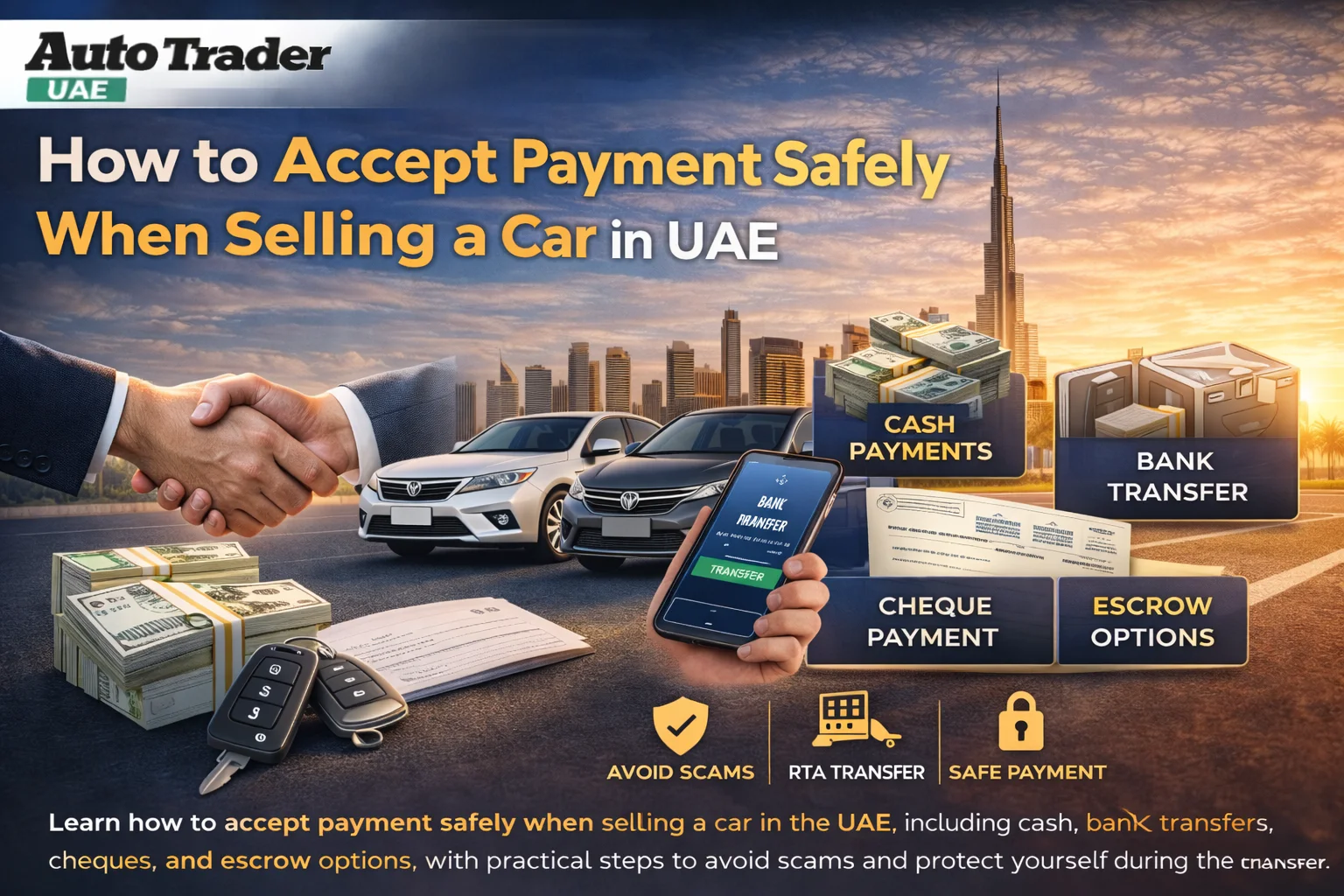
Selling your car in the UAE can be straightforward if you handle payment the right way. The biggest risk isn’t usually the buyer or the car – it’s how the money changes hands. This guide explains exactly how to accept payment safely when selling a car in the UAE, which methods are safest, and the red flags to avoid, so you can complete your sale confidently and securely.
Why Safe Payment Matters When Selling Your Car
When you sell a car in the UAE, you’re typically dealing with large sums of money. That makes private sellers a target for:
- Fake or bounced cheques
- Reversed or delayed bank transfers
- Counterfeit cash
- Scams around deposits and reservations
The goal is simple: you should only hand over the keys and complete the RTA transfer once the money is confirmed, cleared, and in your account. Auto Trader UAE connects you with serious buyers and helps you advertise your car professionally, but the payment step is ultimately between you and the buyer. Following the steps below will help you stay safe.
The Safest Ways to Accept Payment in the UAE
Different payment methods carry different levels of risk. Here’s what to expect with each option.
1. Bank Transfer (Preferred for Most Private Sales)
Bank transfers between UAE accounts are one of the safest and most convenient options when handled correctly. Pros:
- Funds go directly into your account
- Digital record of the transaction
- No need to count or transport cash
Risks:
- Buyer may show you a scheduled transfer instead of a completed one
- Inter-bank transfers can take time to clear
How to use bank transfer safely:
- Meet during banking hours where possible.
- Share your IBAN and bank details accurately (never share online banking passwords or OTPs).
- Ask the buyer to complete the transfer in front of you via their banking app or at a branch.
- Do not rely on screenshots or WhatsApp confirmations. They can be edited or show only a pending transfer.
- Log into your own mobile or online banking and confirm that the funds are received and available, not just “on the way”.
- Only proceed to the RTA or authorised service centre for transfer after you see the cleared amount in your account.
2. Cash Payment (Safe If You Handle It Correctly)
Cash is immediate, but it comes with safety and counterfeit risks. Pros:
- Instant payment
- No bank delays
Risks:
- Fake or high-quality counterfeit notes
- Personal safety when carrying large amounts of cash
How to handle cash safely:
- Meet in a public, secure location – ideally inside the buyer’s or your bank branch.
- Ask the bank teller to count and verify the cash for both of you.
- Avoid accepting very large amounts of cash in car parks, on the street or at home.
- If you must count cash yourself, do so in a safe, well-lit place and double-check bundles and denominations.
- Deposit the cash into your account immediately if possible.
3. Cashier’s / Manager’s Cheque
A cashier’s or manager’s cheque (issued by a bank on their own account) can be safer than a normal personal cheque, but there are still things to watch. Pros:
- Issued by a bank, not just the buyer
- Often used for higher-value transactions
Risks:
- Forged or altered cheques
- Cheques with conditions (e.g. post-dated)
How to use a bank cheque safely:
- Agree with the buyer beforehand if a manager’s cheque will be used.
- Ask the buyer to obtain the cheque from their bank while you are present or on the same day of transfer.
- Check that the cheque is payable to your full legal name and for the correct amount.
- Avoid post-dated cheques – insist on a cheque that is valid for immediate deposit.
- Where possible, deposit the cheque and wait for it to fully clear before handing over the car.
4. Escrow or Third-Party Payment Services
Some authorised dealers and service providers in the UAE offer escrow-style services: the buyer pays the provider, and the provider releases funds to you once transfer is complete. Pros:
- Reduces direct money handling between buyer and seller
- Can feel more secure for both parties
Risks:
- Additional fees
- Risk of unlicensed or unofficial intermediaries
If you choose this route:
- Use only reputable, licensed companies or known dealership services.
- Avoid unknown individuals or websites offering to "hold" your money.
- Read and understand the service terms, fees and timelines for payout.
5. Payment Methods to Avoid
For private car sales in the UAE, it is usually safest to avoid:
- Personal cheques – they can bounce, leaving you without money or car.
- International transfers from unknown buyers – especially if the buyer has not viewed the car.
- Online wallets or crypto – harder to verify and dispute if something goes wrong.
- Partial payments with promises to pay the rest later – unless you clearly document and don’t release the vehicle or ownership until full payment is received.
Step-by-Step: Safe Payment and Transfer Process
Follow this simple sequence to protect yourself when selling your car in the UAE.
Step 1: Agree the Final Price and Payment Method
- Negotiate and agree a final selling price with the buyer.
- Decide in advance how payment will be made: bank transfer, cash at the bank, or manager’s cheque.
- Clarify who will pay RTA transfer and registration fees.
Step 2: Meet in a Safe Place
- For test drives, meet in a public place during daylight.
- For payment, meet at a bank branch or directly at an RTA centre or authorised testing centre with CCTV and security.
- Avoid inviting strangers to your home where possible.
Step 3: Receive and Confirm the Money
Depending on the agreed method:
- Bank transfer: Confirm the full amount has arrived in your account.
- Cash: Count and verify at the bank; deposit if possible.
- Manager’s cheque: Inspect it and, ideally, confirm with your bank.
Only move to the next step once you’re fully satisfied the funds are genuine and cleared.
Step 4: Complete the RTA Ownership Transfer
At the RTA centre or authorised service centre:
- Ensure the car has a valid passing test (if required).
- Bring your Emirates ID, driving licence and current registration card (Mulkiya).
- The buyer provides their documents and insurance.
- Complete the official ownership transfer process on the RTA system.
- Once the buyer is listed as the new owner and you’ve received payment, hand over the keys and all spare keys, manuals and accessories.
Step 5: Cancel Any Remaining Liabilities
After the sale:
- Cancel any salik tag linked to that car, or transfer it to your new vehicle.
- Notify your insurance company and cancel or transfer the policy if applicable.
- Keep copies of the sale documents and transfer receipt for your records.
How to Avoid Common Car Payment Scams in the UAE
1. Overpayment and Refund Scams
A buyer offers to pay more than your asking price, then asks you to refund the difference. How to stay safe:
- Never accept overpayments from unknown buyers.
- Never send a refund or transfer money to a buyer.
- Only accept the exact agreed amount and verify it is cleared.
2. Fake Proof of Transfer
The buyer shows a screenshot of a bank transfer or a confirmation email, but the money never arrives. How to stay safe:
- Ignore screenshots, PDFs, or emails as proof.
- Log into your own bank and confirm the credit.
- Do not hand over keys or documents until the funds show as available.
3. Deposits and Reservations
Sometimes serious buyers will pay a small deposit to reserve the car. That’s normal, but it should be handled properly. Best practice for deposits:
- Use a small, reasonable amount as a deposit, not the full price.
- Write and sign a simple receipt stating the amount, date, car details and remaining balance.
- Clearly agree if the deposit is refundable or non-refundable and under what conditions.
4. Buyers Who Refuse Safe Payment Methods
If a buyer insists on an unusual payment method or refuses to meet in safe locations, walk away.
- Legitimate buyers will accept bank transfer, cash at a bank, or a proper manager’s cheque.
- If something feels wrong, you are not obliged to complete the sale.
Documentation to Protect Yourself
Having clear paperwork helps protect you if anything is disputed later.
1. Sale Agreement / Receipt
Prepare a simple document that includes:
- Seller’s full name, Emirates ID number and contact
- Buyer’s full name, Emirates ID number and contact
- Car details: make, model, year, colour, VIN/chassis number, plate number
- Odometer reading at time of sale
- Agreed sale price and payment method
- Date and time of sale
- A statement that the buyer has inspected the car and accepts its current condition
- Signatures of both parties
This doesn’t replace the official RTA transfer, but it adds an extra layer of clarity.
2. Proof of Payment
Keep copies of:
- Bank transfer receipts or references
- Cash deposit slips
- Copies or photos of the manager’s cheque (front and back)
- RTA transfer confirmation/receipt
Store these digitally and physically for future reference.
Safe Payment Tips Specifically for the UAE
- Use daytime hours: Arrange payment and transfer during normal working hours when banks and RTA centres are open.
- Bring a friend or family member: There is safety in numbers, especially if large amounts of cash are involved.
- Know local rules: RTA procedures can vary slightly by emirate, so check local requirements in Dubai, Abu Dhabi, Sharjah or others before your appointment.
- Be transparent but careful: Provide necessary details to the buyer (IBAN, car information) but never share one-time passwords, banking PINs, or full account access.
- Use reputable platforms: Advertising through recognised platforms like Auto Trader UAE helps you connect with more serious, traceable buyers.
Buyer Takeaway: Paying Safely When You’re the Buyer
If you’re the buyer, you also need to protect your money:
- Only pay the full amount once the seller is present with the car and documents.
- Prefer bank transfers or manager’s cheques over carrying large cash sums.
- Make sure the car passes inspection and the RTA transfer is successful before you consider the deal complete.
- Use a written receipt and keep all proof of payment.
Seller Takeaway: Your Safe Payment Checklist
Before you hand over your car, confirm you have:
- Agreed a clear final price and payment method
- Met the buyer in a safe, public or official location
- Verified that the full amount is in your account or verified by the bank
- Completed the RTA ownership transfer
- Issued and kept a copy of a signed receipt or sale agreement
- Cancelled or adjusted your Salik and insurance as needed
Conclusion: Sell Your Car Safely with Auto Trader UAE
Knowing how to accept payment safely when selling a car in the UAE is just as important as pricing it correctly or preparing it for viewings. Choose secure payment methods, verify funds yourself, use official RTA channels, and walk away from anything that feels suspicious. When you’re ready to sell, list your car on Auto Trader UAE to reach serious, in-market buyers across the country. Explore our guides on pricing, paperwork, and inspection, and browse current used car listings to understand market value. By combining safe payment practices with the reach of Auto Trader UAE, you can complete your next car sale confidently, securely, and at the right price.
If you are exploring used cars in Dubai or elsewhere in the UAE, Auto Trader UAE makes it easier to compare listings, prices, trims, mileage, and seller details in one place.