
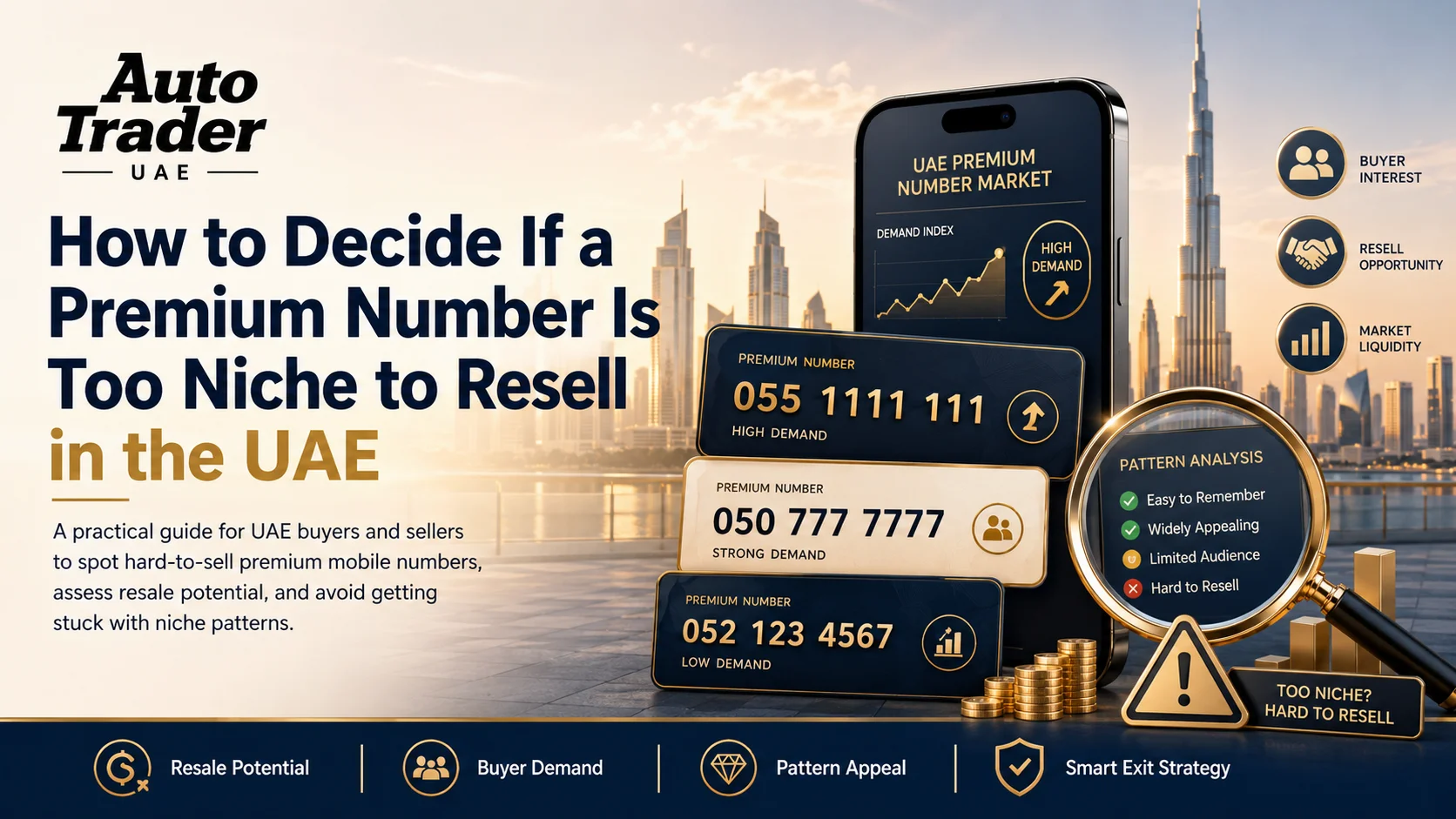
How to Decide If a Premium Number Is Too Niche to Resell
Premium mobile numbers in the UAE can be a smart investment – just like choosing the right car plate or even the right used car. But not every “special” number is easy to resell. Some are simply too niche, with very limited demand, which means your money can stay locked for months or years.
This Auto Trader UAE guide explains how to decide if a premium number is too niche to resell, using practical checks you can apply before you buy. Whether you trade mobile numbers on the side or you’re just considering your first premium number, these steps will help you avoid overpaying for something nobody really wants.
What Makes a Premium Number “Too Niche”?
A premium number is “too niche” when the pool of potential buyers is so small that it becomes very hard to resell at a profit. The number might look clever or meaningful to you, but that doesn’t mean the wider UAE market will pay extra for it.
In simple terms, a number is too niche when:
- It appeals to a very tiny group (for example, one specific name in one language).
- It is strongly tied to a short‑term trend or fading brand.
- It needs explanation before people “get” why it’s special.
- Its price only makes sense for one or two perfect buyers.
The same logic applies when choosing a used car: a rare colour with unusual options may look unique, but it narrows your buyer pool. Premium numbers work the same way.
Step 1 – Check How Universal the Appeal Really Is
Start by asking: “How many different types of people or businesses could realistically want this number?” The broader the appeal, the safer the investment.
Numbers with broad appeal
- Repeating digits (e.g. 050-7777XXX)
- Simple counting patterns (e.g. 052-1234XXX)
- Symmetrical or mirror patterns (e.g. 055-1221XXX)
- Easy-to-remember groups (e.g. 058-8080XXX)
These work like popular body styles in the used car market – similar to a well‑specced سيارة SUV – attractive to families, professionals, and businesses, not just one person type.
Numbers with narrow appeal
- Very specific dates that only matter to a small group (e.g. one wedding date).
- Obscure lucky numbers from a single culture or belief system.
- Inside jokes or coded messages that need explaining.
If you need more than a sentence to explain why the number is special, it’s probably too niche for a confident resale strategy.
Step 2 – Test Demand in the UAE Market
Before committing, do a quick local “demand check”, just like you would before buying a used car to flip.
1. Scan existing listings
- Compare your target number pattern with premium numbers already advertised.
- Note which patterns appear again and again – these are more likely to have proven demand.
- If you see many similar numbers sitting unsold for months, that pattern may be too niche or overpriced.
2. Look at business usage
- Check local ads, shop fronts, car dealer listings, and business cards.
- Notice the types of premium patterns companies actually use.
- If your target style rarely appears in real‑world use, be cautious.
3. Ask dealers and traders
- Talk to people who regularly trade premium numbers.
- Ask which patterns they move quickly and which ones they avoid.
- A consistent “hard to sell” answer is a clear warning sign.
Think of it like browsing used cars in the UAE to see what specs and trims are selling quickly. The numbers that move fast usually share common patterns: simplicity and strong, broad appeal.
Step 3 – Separate Trend-Driven from Timeless
Trendy ideas feel exciting in the moment but may not age well. Timeless patterns stay desirable, just like classic automotive body styles and colours.
Trend-driven examples
- Numbers linked to a temporary social media trend, game, or meme.
- Numbers that copy a currently famous influencer’s number style.
- Numbers tied to a hype brand that could lose relevance.
Timeless examples
- Clean, low-digit numbers.
- Repetitions (e.g. 7777, 8888).
- Simple sequences (e.g. 1234, 4321).
- Balanced, easy-to-say patterns.
If your premium number only makes sense inside a current trend, assume resale risk is high. Timeless patterns are more like well‑specced used SUVs – always in demand on platforms like Auto Trader UAE, regardless of season.
Step 4 – Watch Out for Over‑Personalisation
Deeply personalised numbers limit your buyer pool to the next person who shares the same name, initials, or story. That’s a classic “too niche” trap.
High‑risk personalised patterns
- Full birthdates (DDMMYY) combined with initials.
- Specific names encoded in numbers that only work in one language.
- Inside family references (children’s birthdays in sequence, etc.).
Lower‑risk “soft personalised” patterns
- General lucky numbers popular across multiple cultures in the UAE.
- Balanced patterns that “feel” special but aren’t locked to one person.
- Short memorable sequences that any business could use in adverts.
When your exit strategy relies on finding a buyer with the same story as you, the number is almost always too niche to be a safe investment.
Step 5 – Compare Price vs. Likely Buyer Pool
Sometimes a niche number can still work – but only at the right entry price. Use a simple check:
- Estimate how many realistic buyers exist (not just theoretical buyers).
- Compare your purchase price to more universal premium numbers on the market.
- Ask yourself if a stranger would instantly see the value without explanation.
Consider how car traders work. When they buy a used car in Dubai for resale, they:
- Avoid very unusual specs unless the price is low enough to cover the extra resale time.
- Prefer popular engine sizes, colours, and options that attract plenty of buyers.
- Focus on fast‑moving stock instead of “show pieces” that just sit in the showroom.
Apply the same logic to premium numbers: if you’re paying top tier prices, the number should have top tier demand – not just a clever personal meaning.
Step 6 – Check Memorability in Real Life
A premium number only works if people can remember it easily. Over‑complicated patterns often look special on screen but fail the “spoken out loud” test.
Do the phone test
- Say the number out loud three times, then look away and try to repeat it.
- Ask a friend to hear it once and repeat it after a few minutes.
- If you both struggle, it’s not as premium as it looks.
Many car dealers and service centres choose ultra‑simple numbers because they know customers call from memory. If your target number is hard to say or hard to remember, its value to businesses in the UAE drops sharply – making it much harder to resell.
Step 7 – Consider Compatibility with UAE Languages and Cultures
The UAE is multilingual and multicultural. A strong resale number should work comfortably across Arabic and English speakers – and ideally feel neutral or positive to major communities here.
Red flags that suggest a number is too niche
- It only “reads well” in one language and is confusing or awkward in another.
- It accidentally resembles negative words or phrases when read in Arabic or English.
- It relies on a language‑specific wordplay that loses meaning for others.
Always sanity‑check how the number sounds when an Arabic speaker and an English speaker say it. If it doesn’t travel well between languages, the potential buyer pool is smaller than you think.
Step 8 – Plan Your Exit Before You Buy
With any investment – a premium number, a private plate, or even a used car – you should know your exit strategy before you pay.
Have clear answers to these questions
- Where will you list the number for resale?
- Who are your top three target buyer types (e.g. car dealers, restaurants, small businesses, high‑end service providers)?
- How long are you prepared to hold the number if it doesn’t move quickly?
- What’s your minimum acceptable profit after all costs?
If you cannot clearly define at least two or three strong buyer profiles in the UAE, your number may be too niche for a resell‑driven purchase.
When a Niche Premium Number Can Still Make Sense
There are a few situations where a niche number can be acceptable:
- Personal use first, resale second: You genuinely love the number and will use it for years, and any future resale is just a bonus.
- Deep market knowledge: You trade premium numbers regularly, have a reliable buyer network, and know exactly which niche patterns move within your circle.
- Low entry price: You’re getting a very good deal that reflects the limited demand – and you’re comfortable with a longer holding period.
Outside these cases, it’s usually smarter to put your money into broader‑appeal premium numbers or even into a well‑chosen used car that you can easily flip on Auto Trader UAE.
Practical Checklist: Is This Premium Number Too Niche to Resell?
Before you buy, run through this quick checklist. If you answer “no” to two or more, think carefully.
- Would this number make sense for multiple business types in the UAE (not just one)?
- Does it look good and sound good in both Arabic and English contexts?
- Can most people remember it after hearing it once or twice?
- Is it based on a timeless pattern, not a temporary trend?
- Is the price in line with other premium numbers that clearly have broad demand?
- Can you name at least three realistic buyer profiles who might want it?
If you struggle with these questions, the number is likely too niche for a confident resale strategy.
Linking Your Number Strategy to Your Car Buying Strategy
Buying and selling premium numbers has a lot in common with buying and selling cars in the UAE:
- Liquidity matters: Just as you’d prefer a popular, easy‑to‑sell used SUV, you should prefer popular, easy‑to‑understand number patterns.
- Avoid over‑customisation: Extremely customised specs or extremely personalised numbers both trim your buyer pool.
- Market research wins: Scanning premium number listings is like browsing used cars in Dubai to see what’s priced well and moving fast.
If you’re already researching the market for your next car, it makes sense to keep the same discipline when looking at premium numbers – data and demand first, emotion second.
Buyer Takeaway: Safe Ways to Start with Premium Numbers
If you’re new to premium numbers in the UAE and you want to avoid getting stuck with something too niche, focus on:
- Simple, memorable patterns that work for personal and business use.
- Reasonable entry prices that don’t assume a huge future markup.
- Numbers you’d be comfortable using yourself if resale takes longer than expected.
Approach your first few purchases like your first used car upgrade – avoid risky experiments, aim for proven, reliable value.
Seller Takeaway: How to Present a Niche Number Effectively
If you already own a slightly niche premium number and want the best chance of resale:
- Highlight any universal strengths (simplicity, repetition, easy pronunciation).
- Describe who it suits: luxury car dealerships, service centres, restaurants, or boutique brands.
- Price it realistically against more universal premium numbers, not just against your emotional attachment.
- Be patient – niche numbers take longer to match with the right buyer.
The clearer your description and target buyer, the more likely you are to close a deal.
Conclusion: Focus on Demand, Not Just Difference
The key to deciding if a premium number is too niche to resell is simple: focus on demand, not just uniqueness. A number that feels “special” only to you is a personal purchase, not an investment.
Before you commit, pressure‑test the number for universal appeal, memorability, language compatibility, and price realism. If it performs well on all of these, you’re closer to a smart, resale‑friendly choice.
If you’d rather invest in something with visible, everyday value, consider exploring the wide selection of used cars in the UAE on Auto Trader UAE – including popular used cars in Dubai that already have strong, proven demand. The same disciplined approach you apply to premium numbers will help you choose the right car, at the right price, with a strong future resale potential.
Browse premium mobile numbers in UAE on Auto Trader UAE to compare live listings, prices, and current market activity more clearly.