
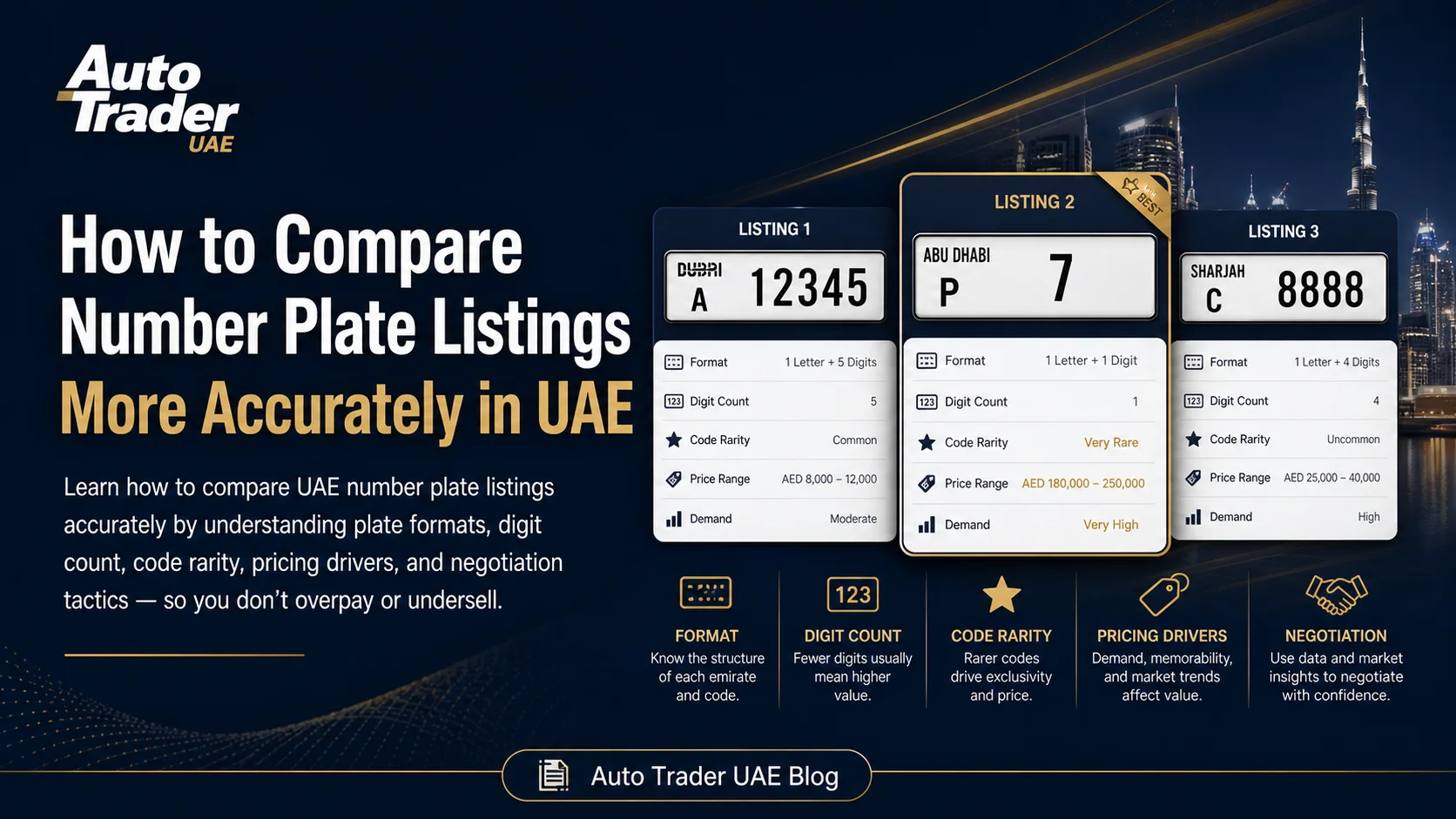
How to Compare Number Plate Listings More Accurately in UAE
Premium number plates in the UAE can cost more than some used cars. With so many listings across different emirates, codes, and digit counts, it’s easy to misjudge a plate’s true value. This guide from Auto Trader UAE explains how to compare number plate listings more accurately in UAE so you buy and sell with confidence.
1. Know the Basic Number Plate Value Drivers
Before you compare listings, understand what usually drives value for UAE number plates:
- Emirate – Dubai and Abu Dhabi plates often attract the strongest demand, followed by Sharjah and other emirates.
- Digit count – Fewer digits (1–4) are typically more desirable and expensive than 5-digit plates.
- Code / Letter – Certain codes or letter series are more prestigious, newer, or rarer.
- Number pattern – Repeated digits, sequences, and symmetrical combinations (e.g. 1111, 2020, 1234) add value.
- Memorable / special meaning – Numbers linked to birthdays, anniversaries, or lucky numbers (like 8 in some cultures) can command a premium.
- Transfer rules & fees – RTA or relevant authority transfer costs and restrictions affect total cost to the buyer.
When you compare any two listings, you should be comparing like for like across these factors as much as possible.
2. Compare by Emirate First
One of the most common mistakes is comparing, for example, a 4-digit Dubai plate with a 4-digit plate from another emirate as if they were equivalent. Demand and prestige differ by emirate.
- Dubai (RTA) – Very active market, strong demand for short plates and attractive codes.
- Abu Dhabi – High profile auctions, strong appetite for distinctive and low-digit plates.
- Sharjah & Northern Emirates – Growing interest, often better value compared with Dubai and Abu Dhabi.
When browsing Auto Trader UAE, try filtering by emirate first. That way you compare Dubai plates against Dubai plates (or Abu Dhabi vs Abu Dhabi) instead of seeing a mixed picture that can distort your price expectations.
3. Always Match Digit Count
Digit count is one of the clearest indicators of a plate’s segment:
- 1–2 digits – Ultra-premium, extremely rare, auction-level prices.
- 3 digits – Very desirable, especially with good patterns.
- 4 digits – Strong demand, wide price range depending on pattern and code.
- 5 digits – Entry into the personalised plate world; still collectible if the pattern is good.
When evaluating price, don’t compare a 5-digit plate with a 3-digit plate just because the numbers look similar. Filter and sort listings on Auto Trader UAE by digit count so you stay within the right tier.
4. Understand Plate Codes, Letters, and Series
Many buyers focus on the digits and ignore the plate code or letter series, but the code can change value significantly.
When comparing listings, ask:
- Is the code newer or older in that emirate? Newer codes can look more modern or less common.
- Does the code have status appeal in local perception? Some series are seen as more prestigious.
- Are there fewer plates issued for that series? Limited series often hold value better.
On Auto Trader UAE, always read the full plate description: emirate + code + number. Only compare plates that are as close as possible in these three aspects.
5. Analyse the Number Pattern Properly
Number pattern can turn an average plate into a highly desirable one. When comparing listings:
5.1 Popular pattern types
- Repeats: 7777, 99999, 1212
- Sequences: 123, 1234, 2345
- Mirrors & symmetry: 1221, 3003, 4554
- Rounded / clean numbers: 1000, 20000, 5050
- Birth year / date patterns: 1988, 1990, 2020
A 4-digit plate with a strong pattern can be worth more than a random 3-digit plate in some cases. When you see two listings with the same digit count and emirate but very different prices, usually the pattern explains why.
5.2 How to compare patterns fairly
When you’re deciding between two or more options:
- Group “plain” random plates together and compare their pricing among themselves.
- Group “patterned” plates (repeats, sequences, etc.) separately.
- Within pattern types, compare strength of pattern (e.g. 1111 is usually stronger than 1011).
6. Check Realistic Asking Prices vs Market Range
Two plates can be similar but still show very different asking prices. To compare more accurately:
- View several active listings on Auto Trader UAE for plates with the same emirate, same digit count, and similar pattern strength.
- Ignore obvious outliers that are far above or below the typical asking price.
- Note the average range for that segment, not just one listing.
- Look at time on market: plates that have been listed for months at the same price might be overpriced.
When selling, price your plate slightly within the realistic range if you want a faster sale. When buying, use the range to know how much room you have for negotiation.
7. Factor In Transfer Fees and Process
Every emirate has its own process and fees for number plate transfer. A fair comparison needs to look at total cost to you, not just the seller’s asking price.
Consider:
- RTA or traffic authority fees for plate transfer or retention.
- Whether a new vehicle registration is required or the plate can be held on a retention certificate.
- Any service center or typing fees the seller expects you to cover.
Ask sellers to clarify who pays which fees before you compare final costs. A cheaper plate with higher administrative costs might end up costing you more overall.
8. Use Photos and Documentation as Comparison Tools
Quality listings usually have:
- Clear, straight-on photos of the plate (or official documentation for off-vehicle plates).
- Accurate description of emirate, code, digit count, and any transfer conditions.
- Contact details that match the name on the registration, or a clear explanation if a broker is involved.
When comparing multiple listings, give more weight to plates with complete information and proof. This reduces the risk of wasting time or facing unexpected issues during transfer.
9. Avoid Common Comparison Mistakes
Here are frequent errors that lead to overpaying or underpricing:
- Comparing across emirates without adjusting for demand differences.
- Ignoring digit count when checking “similar” plates.
- Overestimating weak patterns – not every repeated digit or partial sequence has premium value.
- Copying auction results directly – open auction prices can be exceptional and not always repeatable in private resale.
- Relying on a single listing as the benchmark instead of checking a broader range.
10. Tips for Buyers: Getting the Best Plate for Your Budget
To make number plate comparison work in your favour as a buyer:
- Define your priorities: emirate, digit count, or pattern – which matters most to you?
- Set a realistic budget range after viewing several comparable listings.
- Shortlist 5–10 plates on Auto Trader UAE that match your criteria, then compare them detail by detail.
- Be flexible on patterns: sometimes a slightly less perfect pattern offers much better value for money.
- Negotiate based on facts: reference other live listings with similar specs when making offers.
If you’re also looking to upgrade your car to match your new plate, you can browse a wide range of used cars in UAE to complete your setup.
11. Tips for Sellers: Positioning Your Plate Correctly
To price and present your plate competitively:
- Research similar plates in the same emirate, with the same digit count and comparable patterns.
- Avoid emotional pricing – your personal attachment or lucky meaning may not fully translate to buyers.
- Use high-quality photos and a clear description that includes emirate, code, digit count, pattern type, and transfer conditions.
- Offer a fair negotiation margin – pricing slightly above your minimum allows room for serious offers.
- Highlight objective strengths: short digit count, strong pattern, desirable emirate or code.
If you’re selling your plate because you’re changing vehicles, listing your car on Auto Trader UAE alongside your plate can attract buyers interested in a complete package.
12. How Auto Trader UAE Helps You Compare Number Plate Listings
Using Auto Trader UAE to compare plates makes the process more structured and transparent:
- Search filters help you narrow down by emirate, price, and other details.
- Multiple listings in each segment give you a realistic view of the live market.
- Direct contact with sellers lets you clarify transfer details before committing.
Whether you’re pairing a plate with a daily commuter or a high-end SUV, you can also explore the latest used cars in UAE and more specific city options like used cars in Dubai to find the right match.
13. Final Buyer & Seller Checklist
When comparing number plate listings in the UAE, always cross-check:
- Emirate
- Digit count
- Code / letter series
- Pattern type and strength
- Asking price vs similar active listings
- Transfer rules, fees, and total cost
- Photo clarity and documentation
By focusing on these factors and using Auto Trader UAE to see a wide range of options, you’ll be able to compare number plate listings more accurately, avoid common pricing traps, and secure a plate that truly fits your budget and style.
Browse number plates in UAE on Auto Trader UAE to compare live listings, prices, and current market activity more clearly.
Related Links
Buyer Takeaway
When buying a used car in the UAE, focus on vehicle condition, service history, inspection quality, paperwork, and total running costs rather than price alone. Compare options carefully and choose the option that best matches your budget and real needs.
Seller Takeaway
If you are selling a used car in the UAE, present the service history clearly, price the vehicle realistically, and highlight condition, specification, and ownership strengths honestly. A well-prepared listing with accurate details usually attracts more serious buyers.
Conclusion
A careful used car purchase in the UAE starts with research, proper inspection, and clear paperwork before making the final decision.