
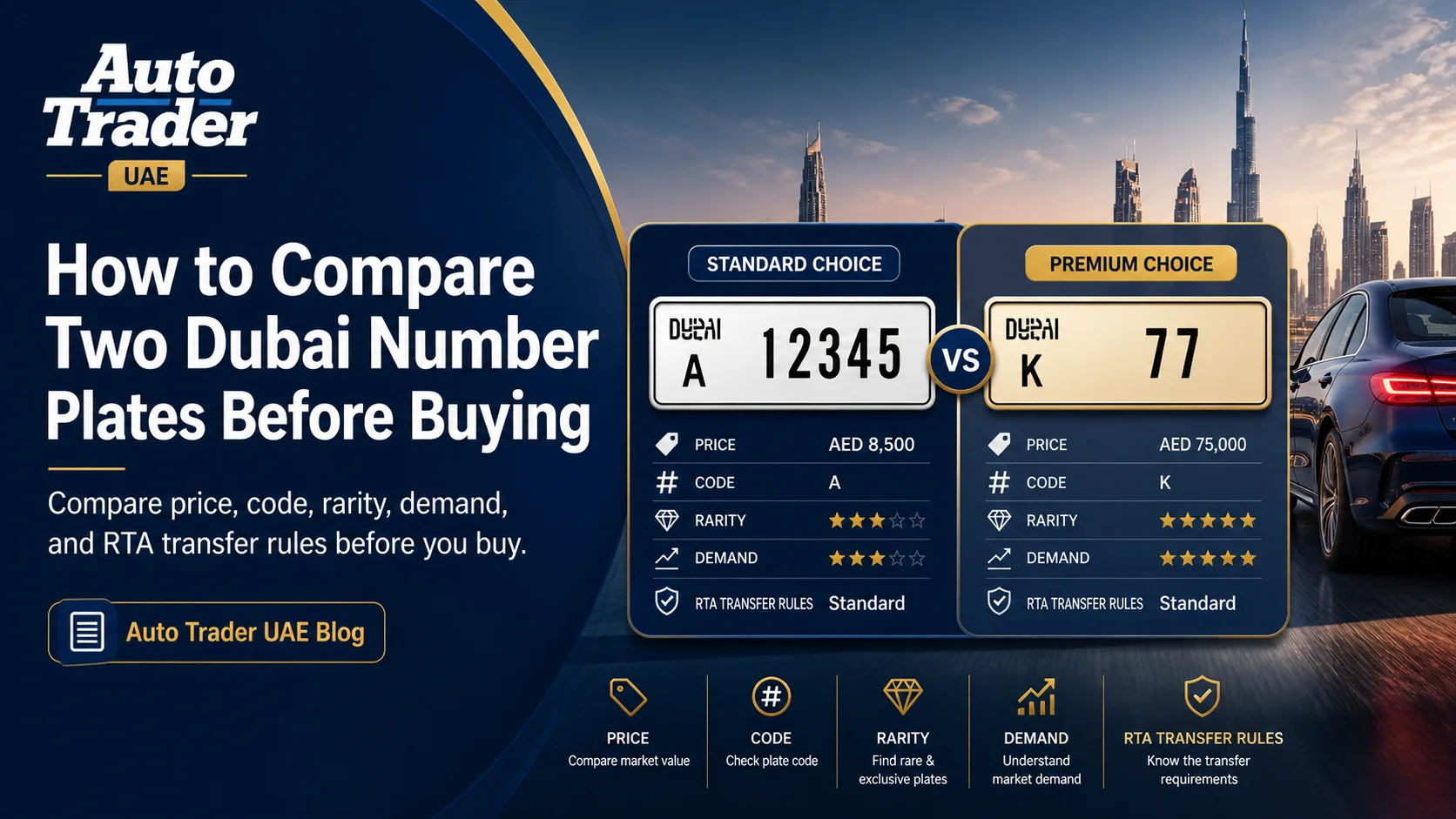
How to Compare Two Dubai Number Plates Before Buying
Dubai number plates are more than just registration details – they’re status symbols, investment assets, and a key part of how your car looks on the road. If you’re choosing between two plates, knowing how to compare them properly can save you money and help you make a smarter decision.
This guide from Auto Trader UAE explains how to compare two Dubai number plates before buying, what really affects value, and how to complete a safe transfer.
1. Start with the Basics: Code, Digits, and Format
When comparing two Dubai plates, begin with the core elements that define value:
1.1 Plate code (single letter vs double letter)
- Single-letter codes (like A, B, C) are generally more prestigious and often more expensive than later or dual-letter codes.
- Popular early codes (such as A, E, F) usually attract more demand than newer or less common series.
When comparing two plates, note:
- Are they from the same code? If yes, compare the digits more closely.
- If one has a stronger code (for example, single-letter vs a newer series), it typically carries more long-term appeal.
1.2 Number of digits (1–5 digits)
In general, fewer digits = higher value, assuming similar code and pattern:
- 1–2 digit plates: extremely rare, often collectors’ items.
- 3–4 digit plates: popular with enthusiasts and status-focused buyers.
- 5 digit plates: most common, but still vary in value based on the number pattern.
When comparing two plates:
- If codes are similar, a 3-digit plate usually beats a 4 or 5 digit on prestige.
- If one plate has more digits but a very strong pattern (like 11111 or 10000), it may still be more desirable.
1.3 Plate format and visual balance
Stand back and look at how each plate visually sits on a car:
- Is one plate easier to read at a glance?
- Does the code + number look balanced (e.g. E 400 vs E 49371)?
- Would it suit a premium used car in the UAE or a supercar?
2. Compare Number Patterns and Memorability
Two plates with the same digits and code length can still have very different value because of how the numbers are arranged.
2.1 Repeating numbers
Patterns like 1111, 22222, 7777, 8888 are highly desirable and easy to remember. When comparing:
- A plate like F 7777 will usually beat F 7234 on desirability.
- Plates with partial repeats (e.g. 7878, 5566, 0099) often carry a premium over random combinations.
2.2 Sequences and tidy numbers
- Sequential numbers: 1234, 2345, 4567 are attractive, especially in shorter digit formats.
- Clean endings: numbers like 1000, 20000, 300 are often more valuable than similar but messy sequences.
- Palindromes: numbers that read the same forwards and backwards (e.g. 1221, 4554) also attract interest.
When comparing two plates, ask:
- Which one is faster to memorise?
- Which plate will people remember when they see it once on the road?
2.3 Cultural and personal significance
In the UAE, some digits (like 8 in some cultures) can be seen as lucky, and numbers tied to birthdays, anniversaries, or business dates can carry personal value.
Compare both plates for:
- Numbers matching your mobile number or brand.
- Digits with cultural or personal meaning to you or potential future buyers.
3. Check Market Value and Recent Sale Prices
Once you’ve compared the codes and patterns, you need to check the real-world market value of each plate.
3.1 Look at current listings
Search live Dubai plate listings on platforms like Auto Trader UAE and compare:
- Similar code and digit count (e.g. same letter and 3/4/5 digits).
- Similar pattern style (repeating numbers, tidy numbers, etc.).
- How long the plates seem to stay listed before they’re marked as sold.
If one of your plates is closer in style to those listed at a consistently higher price, it probably has the stronger value potential.
3.2 Compare asking price vs. realistic value
Sellers may list plates at “wish prices” that are higher than what buyers are willing to pay. When comparing two plates:
- Check multiple platforms, not just one asking price.
- Look for recently sold examples (if visible) with similar specs.
- Be cautious with extremely low prices – this may point to distress sales or potential issues.
3.3 Consider long-term resale
If you’re treating the plate as an investment, think about which one will be easier to resell in 3–5 years:
- Timeless, simple numbers tend to hold demand.
- Overly personalised or complicated combinations may be harder to move on later.
4. Verify Ownership and RTA Eligibility
Before choosing between two plates, make sure both can be legally transferred and are clear of any issues with the Roads and Transport Authority (RTA) in Dubai.
4.1 Confirm plate ownership
Always verify that the seller is the registered owner of the plate:
- Ask to see the RTA certificate or documentation showing the plate is in their name.
- Make sure the plate is not still tied legally to a vehicle that has unpaid fines or finance.
4.2 Check fines and restrictions
Ask the seller to confirm that:
- There are no outstanding fines or blocks connected to that plate number.
- The plate is clear and available for immediate transfer via RTA.
If one of the two plates has a simpler, cleaner transfer path with RTA while the other looks complicated, that should influence your decision.
4.3 Plate type and legality
Make sure both plates are genuine Dubai RTA plates, not replicas or novelty plates. Compare:
- Design style and font
- RTA branding and holograms (if applicable)
- Any mismatched details that look unofficial
5. Compare Compatibility with Your Car and Image
A plate can look and feel very different depending on the car it’s mounted on. When deciding how to compare two Dubai number plates before buying, always factor in the vehicle you’ll use.
5.1 Match the plate to the car type
- For a luxury sedan (e.g. S-Class, 7 Series), shorter and cleaner numbers usually look better.
- For a sports car or supercar, a distinctive or low-digit plate can help the car stand out.
- For a daily driver or family SUV, a neat 4–5 digit pattern can offer a balance of value and practicality.
If you are still looking for the right car to match your new plate, browse:
5.2 Consider your personal or business brand
Ask yourself for each plate:
- Does this plate feel professional enough if it’s a company vehicle?
- Does it reflect my image or lifestyle – subtle, luxury-focused, or attention-grabbing?
- Will I still be comfortable with this plate a few years from now?
6. Factor in Total Cost: Plate, Transfer, and Vehicle
When comparing two plates, don’t just look at the sticker price. Calculate the complete cost of owning and using each one.
6.1 Purchase price vs. total outlay
For each plate, list:
- Plate purchase price agreed with the seller.
- RTA transfer fees for the plate.
- Any additional costs if you are buying a car specifically to put this plate on.
6.2 Budget vs. emotional buying
Number plates are emotional purchases for many buyers. To compare two plates rationally:
- Decide on a maximum budget before negotiations.
- Do not exceed your limit just because a plate feels more prestigious.
- Account for the cost of the car itself – especially if you still plan to buy a used car in the UAE afterwards.
7. Negotiating and Choosing Between Two Plates
Once you’ve compared the technical and market factors, you’re ready to choose and negotiate.
7.1 Shortlist on logic first
Make a simple comparison table for both plates:
- Code and digit count
- Pattern strength and memorability
- Estimated market value
- RTA transfer simplicity
- Match with your car and image
Based on this, decide which plate is objectively stronger. Then ask yourself if your personal preference lines up with that choice.
7.2 Use comparisons to negotiate
When speaking with each seller, you can use your research to negotiate:
- Explain you are choosing between two similar plates.
- Share realistic market ranges (if the seller seems open to it).
- Be ready to walk away if the price does not make sense.
7.3 Consider timing and opportunity
Some plates are unique opportunities – you may not see that exact combination again. When comparing two options, think about:
- Which plate is more likely to reappear in the market in another form?
- Which one feels truly one-of-a-kind for you?
8. Safe Transfer Process with Dubai RTA
After you choose between the two plates, make sure the transfer is done correctly through Dubai’s Roads and Transport Authority (RTA).
8.1 Agree the deal in writing
Before heading to transfer:
- Agree on the final price in writing (message or simple agreement).
- Confirm who pays RTA transfer fees.
- Agree the date and RTA centre where the transfer will happen.
8.2 Complete transfer through official channels
Transfer should only be done through official RTA channels (online or at an RTA centre). Typically, you will need:
- Emirates ID and other valid ID documents.
- Seller and buyer present, or authorised representatives.
- A vehicle to assign the plate to, or a holding arrangement if permitted by RTA at that time.
Never hand over full payment before confirming the plate is successfully transferred to your name in the RTA system.
8.3 Keep all receipts and documents
For future resale, keep:
- RTA transfer receipt and confirmation.
- Any original plate certificate or documentation.
- Proof of payment to the seller.
9. When to Walk Away from a Plate Deal
Sometimes, the best comparison result is to buy neither plate.
Consider walking away if:
- The seller refuses to use official RTA channels.
- The asking price is far above similar plates on the market.
- Ownership or documentation feels unclear or inconsistent.
- You need to stretch your budget too far, leaving no room for the right car.
There will always be new plate opportunities. It is better to wait than rush into a bad or risky deal.
10. Final Buyer and Seller Tips
10.1 For buyers
- Decide your budget and style (low digits, repeating numbers, or just a clean pattern) before you start searching.
- Always compare at least two or three plates side by side before committing.
- Use the plate to complement a car you love – explore used cars in Dubai and across the UAE to find the right match.
10.2 For sellers
- Research similar plates to set a realistic asking price.
- Highlight the plate’s strengths: code, digits, pattern, and any memorable or lucky sequences.
- Be ready to show clear RTA proof of ownership to build buyer confidence.
Conclusion: Making a Smart Plate Choice with Auto Trader UAE
Knowing how to compare two Dubai number plates before buying helps you combine logic, style, and long-term value. By looking at code, digits, pattern, market data, and RTA rules together, you can confidently choose the plate that truly suits you.
Whether you’re pairing a special plate with a performance coupe, luxury sedan, or family SUV, Auto Trader UAE makes it easy to find the right used car in the UAE and the right deal in Dubai. Compare plates carefully, transfer safely, and enjoy the unique identity your Dubai number plate brings to every drive.
Browse number plates in UAE on Auto Trader UAE to compare live listings, prices, and current market activity more clearly.
Related Links
Buyer Takeaway
When buying a used car in the UAE, focus on vehicle condition, service history, inspection quality, paperwork, and total running costs rather than price alone. Compare options carefully and choose the option that best matches your budget and real needs.
Seller Takeaway
If you are selling a used car in the UAE, present the service history clearly, price the vehicle realistically, and highlight condition, specification, and ownership strengths honestly. A well-prepared listing with accurate details usually attracts more serious buyers.